

Top 10 Salesforce Alternatives for Small Businesses in 2026
Enterprise Features Without Enterprise Costs: Affordable CRM Solutions That Actually Work
Salesforce is too expensive for most small businesses, with pricing starting at $25 per user per month and quickly escalating to $100+ per user for essential features. For a team of 10 users, you’re looking at annual costs of $12,000 to $50,000+ for Salesforce licenses alone, before factoring in implementation costs ($25,000+) and consultant fees ($150-$250/hour). The good news? Modern CRM alternatives deliver enterprise-grade features at a fraction of the cost—and some even offer one-time payments instead of never-ending subscriptions.
This comprehensive guide examines the 10 best Salesforce alternatives for small businesses, with detailed pricing comparisons, feature breakdowns, and real-world cost analysis. Whether you need self-hosted data control, simpler interfaces, or just want to escape subscription fatigue, you’ll find a better-fit CRM solution below.
We’ve researched each platform’s current pricing, verified features directly from official sources, and created comparison tables to help you make an informed decision. Let’s dive into solutions that won’t drain your budget while still delivering the CRM capabilities your business needs.
Grow CRM
The All-in-One Self-Hosted CRM with One-Time Payment
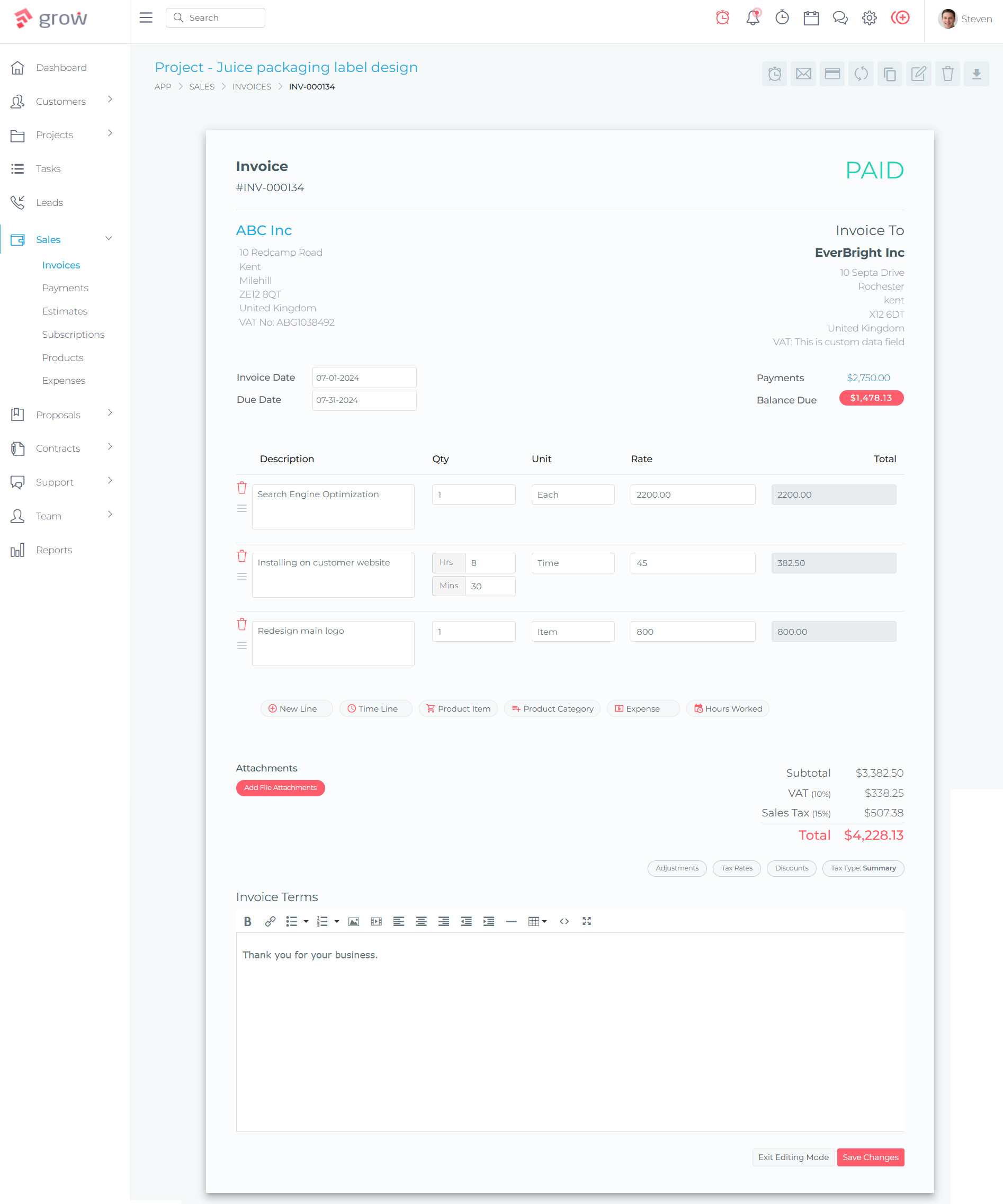
Grow CRM stands out as the #1 Salesforce alternative for small businesses because it eliminates the subscription model entirely. For just $54 one-time payment, you get unlimited users, lifetime updates, and a comprehensive suite of business tools that most companies cobble together from 3-5 separate subscriptions. Built on the modern Laravel framework, Grow CRM combines CRM, project management, invoicing, time tracking, and helpdesk functionality into a single, self-hosted platform.
Unlike Salesforce’s complex, overwhelming interface designed for enterprise teams, Grow CRM offers an intuitive, clean dashboard that new team members can navigate within minutes—no expensive training required. The self-hosted architecture means you maintain complete control over your customer data, host it on your own servers, and never worry about per-user fees as your team grows. The Grow CRM team even provides free installation and setup services, handling the technical aspects to ensure a smooth launch.
What makes Grow CRM particularly compelling for small businesses is the total cost of ownership comparison. While a 10-person team would pay $3,000-$12,000 annually for Salesforce (and that cost persists every year), Grow CRM’s $54 one-time investment delivers a five-year savings of $14,946 to $59,946. For budget-conscious small businesses, this dramatic cost difference allows you to invest those savings into growth, marketing, or hiring instead of feeding an endless subscription.
Key Features:
- One-Time Payment Model: $54 total cost with lifetime updates—no monthly fees ever
- Unlimited Users: Add your entire team without worrying about per-seat charges
- Complete CRM Suite: Lead management, contact tracking, deal pipelines, and sales forecasting
- Integrated Project Management: Milestones, tasks, Kanban boards, and Gantt charts built-in
- Professional Invoicing: Create, send, and track invoices with multiple payment gateway integrations (Stripe, PayPal, Mollie, Razorpay, Tap)
- Built-in Time Tracking: Log billable hours directly within projects and convert to invoices instantly
- Helpdesk & Ticketing: Manage customer support requests without needing a separate tool
- Client Portal: Give customers secure access to their projects, invoices, and tickets
- Self-Hosted & Private: Full data control on your own servers—no third-party data risks
- 30 Languages: Multi-language support for global teams and international clients
- Custom Fields & Workflows: Tailor the CRM to match your unique business processes
- REST API Access: Build custom integrations and extend functionality as needed
- Free Installation Service: Expert setup included at no additional cost
✅ Pros
- Unbeatable value: $54 one-time vs. $1,000s annually with competitors
- True all-in-one platform eliminates need for separate PM, invoicing, and time tracking tools
- Unlimited users with no per-seat pricing—scale freely
- Complete data ownership and privacy with self-hosted deployment
- Modern Laravel framework makes customization straightforward for developers
- Free installation service and lifetime updates included
❌ Cons
- Self-hosted requires your own web hosting (typically $5-20/month)
- Not ideal if you prefer fully managed SaaS solutions (though SaaS version available for $169)
- Smaller ecosystem compared to Salesforce’s marketplace
💰 Pricing
Self-Hosted Version: $54 one-time payment (lifetime updates included)
SaaS Version: $169 one-time payment (for reselling CRM services)
Additional Costs: Web hosting only (~$5-20/month for shared hosting, $20-100/month for VPS)
5-Year TCO (10 users): ~$54 + hosting = $354-$6,054 total vs. Salesforce’s $15,000-$60,000
HubSpot CRM
Powerful Free Tier with Scalable Paid Plans
HubSpot CRM offers an impressive free-forever plan that delivers real value to small businesses, making it a standout Salesforce alternative. Unlike Salesforce’s limited trials, HubSpot lets you manage unlimited contacts and up to 2 users at no cost, providing a legitimate way to implement professional CRM tools without financial commitment. The platform’s intuitive interface requires minimal training, and the free tier includes contact management, deal tracking, email integration, and basic reporting—features that would cost you hundreds monthly with Salesforce.
When your business grows beyond the free tier’s capabilities, HubSpot’s pricing becomes less attractive. The Professional plan jumps to $500 monthly with only 3 seats included, and additional users cost $50 per month each. However, for very small teams (2-3 people), HubSpot’s free plan combined with one or two free marketing/sales tools creates a powerful, cost-effective stack. The platform excels at marketing automation and inbound methodology, making it particularly valuable for businesses focused on content marketing and lead nurturing.
Key Features:
- Free plan with unlimited contacts, companies, deals, and tickets
- Contact and company management with detailed activity tracking
- Email integration and tracking with Gmail and Outlook
- Deal pipeline management with visual Kanban boards
- Marketing automation (paid plans) with email workflows and landing pages
- Predictive lead scoring and behavioral triggers (Professional+)
- Custom reporting dashboards and analytics
- Extensive integration marketplace (400+ apps)
✅ Pros
- Genuinely useful free plan (not just a trial)
- Excellent for inbound marketing and content-driven businesses
- User-friendly interface with minimal learning curve
- Strong integration ecosystem
❌ Cons
- Expensive once you outgrow free tier ($500/month for Professional)
- Add-on costs accumulate quickly
- Professional plans require expensive onboarding
- Limited customization compared to self-hosted options
💰 Pricing
Free Plan: $0 (unlimited contacts, up to 2 users)
Professional Plan: $500/month (3 seats included, $50/month per additional seat)
5-Year TCO (10 users): $42,000+ (Professional tier with 10 users)
Zoho CRM
Feature-Rich Platform with Affordable Pricing Tiers
Zoho CRM delivers tremendous value for small businesses seeking Salesforce-level features without the enterprise price tag. Starting at just $14 per user per month (billed annually), Zoho costs nearly half of Salesforce’s entry-level pricing while offering comparable contact management, pipeline tracking, and automation capabilities. The platform provides a free plan for up to 3 users, making it accessible for micro-businesses and solopreneurs to test before committing.
However, Zoho’s comprehensive feature set comes with a complexity trade-off. The platform offers an overwhelming number of modules, settings, and configuration options that can feel daunting for teams without dedicated administrators. While this flexibility appeals to businesses with specific workflow requirements, it creates a steeper learning curve compared to simpler alternatives like Pipedrive or Capsule. The Standard plan ($14/user/month) includes essential features like custom dashboards, workflows, and mass emailing (250 daily emails), making it suitable for most small business needs.
Key Features:
- Comprehensive contact and lead management
- Multiple sales pipelines with custom stages
- Workflow automation and custom fields
- Lead scoring and sales forecasting
- Zia AI assistant (Enterprise plan) for smart insights
- Blueprint process management (Professional+)
- Advanced analytics and custom reports
- Multi-channel communication (email, phone, social)
✅ Pros
- Affordable entry point at $14/user/month
- Free plan for up to 3 users
- Extensive customization and workflow options
- Part of larger Zoho ecosystem (accounting, projects, etc.)
❌ Cons
- Interface complexity can overwhelm new users
- Steep learning curve for advanced features
- Mobile app less intuitive than competitors
- Email limit (250/day on Standard) may restrict campaigns
💰 Pricing
Free Plan: $0 (up to 3 users, basic features)
Standard: $14/user/month (annual) or $20/month (monthly billing)
Professional: $23/user/month (annual) or $35/month (monthly billing)
Enterprise: $40/user/month (annual)
5-Year TCO (10 users): $8,400 (Standard) to $24,000 (Enterprise)
Pipedrive
Sales-Focused CRM Built for Pipeline Management
Pipedrive takes a laser-focused approach to CRM by prioritizing visual pipeline management and sales activity tracking above all else. Starting at $14 per user per month (billed annually), Pipedrive offers an intuitive drag-and-drop interface that sales teams can master in hours rather than days. The platform was built by salespeople for salespeople, and this focus shows in its streamlined deal tracking, activity-based selling approach, and minimal feature bloat.
While Pipedrive excels at core sales functions, it lacks the broader business management capabilities of all-in-one solutions like Grow CRM. There’s no built-in project management, invoicing, or helpdesk functionality—you’ll need separate tools for those needs. However, for businesses primarily concerned with converting leads through a defined sales process, Pipedrive’s simplicity becomes its greatest strength. The platform includes 400+ integrations to connect with other business tools, and its reporting provides clear visibility into sales performance metrics.
Key Features:
- Visual pipeline management with drag-and-drop interface
- Unlimited custom pipelines for different sales processes
- Activity-based selling with task scheduling and reminders
- Contact and lead management with unlimited records
- Email integration and tracking
- AI-powered sales reporting and forecasting (higher tiers)
- Mobile apps for iOS and Android
- 400+ integrations including Zapier, Slack, Trello
✅ Pros
- Extremely intuitive interface with minimal training needed
- Excellent visual pipeline management
- Affordable starting price at $14/user/month
- 14-day free trial to test before committing
❌ Cons
- Limited features beyond core sales functions
- Essential add-ons (LeadBooster, Campaigns) cost extra
- No built-in invoicing, project management, or helpdesk
- Annual commitment required for best pricing
💰 Pricing
Essential: $14/user/month (annual) or $24/month (monthly)
Advanced: $24/user/month (annual)
Professional: Starting at higher tiers
Power & Enterprise: Up to $99/user/month
5-Year TCO (10 users): $8,400 to $59,400 depending on tier and add-ons
Freshsales
AI-Powered CRM with Built-in Communication Tools
Freshsales (by Freshworks) positions itself as an affordable Salesforce alternative with standout AI capabilities and built-in calling, email, and chat functionality. Starting at just $9 per user per month, Freshsales offers nearly 10x cost savings compared to Salesforce while delivering essential CRM features plus intelligent lead scoring through its Freddy AI assistant. The platform’s clean, kanban-style pipeline interface makes deal tracking visual and intuitive, and every customer interaction auto-logs to contact records for complete visibility.
The free plan supports up to 3 users with basic features, though it notably excludes communication channels like SMS, WhatsApp Business, and Facebook messaging. The Growth plan ($11/user/month) unlocks these channels and adds workflow automation, making it suitable for teams ready to scale their customer engagement. Freshsales particularly shines for businesses that want integrated communication without juggling separate tools—you can call prospects, send emails, and manage chat conversations directly within the CRM interface.
Key Features:
- Built-in phone, email, and chat capabilities
- Freddy AI lead scoring and engagement analytics
- Visual kanban deal pipeline
- Workflow automation for repetitive tasks
- Contact and deal management
- Comprehensive reporting dashboards
- Mobile apps for field sales teams
- Integration with Freshdesk for unified support
✅ Pros
- Extremely affordable starting at $9-11/user/month
- Built-in calling and communication tools eliminate need for separate platforms
- AI-powered lead scoring highlights warm prospects
- Free plan available for up to 3 users
❌ Cons
- Free plan lacks multi-channel communication features
- Limited customization compared to self-hosted options
- Advanced features require higher-tier plans ($47-71/user/month)
- Smaller integration ecosystem than HubSpot or Salesforce
💰 Pricing
Free Plan: $0 (up to 3 users, basic features only)
Growth: $11/user/month (annual billing)
Pro: $47/user/month (annual billing)
Enterprise: $71/user/month (annual billing)
5-Year TCO (10 users): $6,600 (Growth) to $42,600 (Enterprise)
Insightly
CRM with Integrated Project Management
Insightly combines customer relationship management with project and task management capabilities, making it appealing for small businesses that need to track both sales opportunities and project delivery. Starting at $29 per user per month (annual billing), Insightly sits in the mid-range pricing tier but delivers value through its unified approach to managing the entire customer lifecycle—from initial lead capture through project completion.
The platform provides a free version for up to 2 users, allowing micro-teams to test the full feature set before committing. Insightly’s workflow automation tools rival standalone business process management solutions, making pipeline management streamlined and consistent. However, the platform now only offers annual billing, eliminating monthly payment flexibility. For teams seeking a middle ground between simple sales-focused CRMs and complex enterprise platforms, Insightly offers scalable functionality without Salesforce’s overwhelming complexity.
Key Features:
- Contact and opportunity management
- Integrated project and task management
- Workflow and process automation
- Lead tracking with web form capture
- Custom email templates and campaigns
- Price books and quote generation
- Real-time sales insights and reporting
- Mobile apps for on-the-go access
✅ Pros
- Combines CRM with project management in one platform
- Strong workflow automation capabilities
- Free version for up to 2 users
- Suitable for service businesses managing client projects
❌ Cons
- Annual billing only—no monthly payment option
- Mid-tier pricing ($29/user/month) less competitive than alternatives
- Interface can feel dated compared to newer platforms
- Limited integrations compared to market leaders
💰 Pricing
Free Plan: $0 (up to 2 users)
Plus: $29/user/month (annual billing required)
Professional: $49/user/month (annual billing)
Enterprise: $99/user/month (annual billing)
5-Year TCO (10 users): $17,400 (Plus) to $59,400 (Enterprise)
SuiteCRM
Open Source Alternative with Enterprise Flexibility
SuiteCRM stands as the leading open-source CRM alternative to Salesforce, offering complete data ownership, high customizability, and zero licensing fees. The software itself is entirely free to download and install on your own servers, covering the full customer lifecycle including leads, accounts, opportunities, cases, quotes, campaigns, and workflow automation. For businesses with technical resources or development teams, SuiteCRM provides enterprise-grade CRM functionality without the vendor lock-in.
However, the “free” designation requires context. While there are no software licensing costs, you’ll need to budget for hosting infrastructure, security maintenance, updates, and either in-house technical staff or developer contractors to customize and manage the system. Implementation costs typically range from $8,000 to $40,000 depending on customization needs, and ongoing maintenance adds $100-200 per hour for developer support. For businesses with existing IT infrastructure and technical expertise, these costs can still represent substantial savings compared to Salesforce’s per-user fees over time.
Key Features:
- Complete CRM functionality: leads, contacts, accounts, opportunities
- Sales automation and pipeline management
- Marketing automation with email campaign manager
- Case management and customer support tools
- Quotes and invoicing capabilities
- Workflow automation and process management
- Module builder and customization studio
- REST API for integrations and extensions
✅ Pros
- Zero licensing fees—completely free software
- Full source code access for unlimited customization
- Complete data ownership and control
- Active open-source community for support
❌ Cons
- Hidden costs: hosting, security, maintenance, and development time
- Requires technical expertise to deploy and manage
- Implementation costs ($8,000-$40,000) can be significant
- Interface feels dated compared to modern SaaS platforms
💰 Pricing
Software License: $0 (free open source)
Implementation: $8,000-$40,000 (one-time)
Hosting: $50-$500/month (depending on infrastructure)
Maintenance: $100-$200/hour (developer support as needed)
5-Year TCO (10 users): $11,000-$70,000+ depending on customization and support needs
EspoCRM
Lightweight Open-Source CRM for Small Teams
EspoCRM delivers a streamlined, open-source CRM solution that’s particularly well-suited for small businesses and startups seeking self-hosted deployment without the complexity of larger enterprise platforms. Available for free download and installation, EspoCRM provides essential contact management, opportunity tracking, and task organization in a clean, modern interface that feels more contemporary than many open-source alternatives.
The platform scales from small businesses to larger organizations, offering flexibility in deployment and customization. Built on a lightweight architecture, EspoCRM requires only a web server with PHP support and MySQL/MariaDB database—making it accessible to teams with basic technical capabilities. While it lacks some advanced features found in SuiteCRM, this simplicity becomes an advantage for teams that want straightforward CRM functionality without overwhelming configuration options. Self-hosted deployment means you control all customer data locally with no database size limitations, though you assume full responsibility for server maintenance and security.
Key Features:
- Contact and account management with detailed profiles
- Opportunity and pipeline tracking with custom stages
- Task and activity management
- Lead capture and qualification workflows
- Built-in email client integration
- Custom reports and analytics
- Calendar and meeting scheduling
- REST API for custom integrations
✅ Pros
- Free open-source software with no licensing costs
- Modern, clean interface compared to other open-source CRMs
- Lightweight requirements (PHP + MySQL)
- Complete data control with self-hosted deployment
❌ Cons
- Requires technical knowledge for setup and maintenance
- Smaller community and ecosystem than SuiteCRM
- Limited out-of-the-box integrations
- Responsible for all server maintenance and security
💰 Pricing
Software License: $0 (free open source)
Hosting: $5-$100/month (shared hosting to VPS)
Setup/Customization: Variable (depends on technical resources)
5-Year TCO (10 users): $300-$6,000 (primarily hosting costs)
Vtiger CRM
All-in-One Platform with Marketing, Sales, and Service
Vtiger CRM combines marketing automation, sales pipeline management, helpdesk support, project management, and inventory control into a unified platform. Starting at $12 per user per month (One Growth plan with annual billing), Vtiger offers comprehensive functionality at a competitive price point. Standard users gain full access to five integrated apps—Marketing, Sales, Help Desk, Projects, and Inventory—making it suitable for businesses seeking an all-in-one solution without piecing together multiple tools.
Recent feature updates demonstrate Vtiger’s commitment to evolving with modern business needs, including QR code integration for streamlined customer interactions, advanced call management for team productivity, and enhanced social media integration (Facebook, WhatsApp via Twilio). The platform caps the One Growth plan at 15 users and 100,000 records, which may limit scalability for rapidly growing businesses. The One Professional ($30/user/month) and One Enterprise ($42/user/month) tiers remove these restrictions while adding advanced features like lead scoring, multi-currency support, and automated time tracking.
Key Features:
- Unified platform: Marketing, Sales, Support, Projects, Inventory
- Contact and deal pipeline management
- Marketing automation with email campaigns
- Helpdesk ticketing system
- Project management with task tracking
- Inventory and order management
- Social media integration (Facebook, WhatsApp)
- Lead scoring and sales insights (Professional+)
✅ Pros
- Affordable all-in-one platform at $12/user/month
- Five integrated apps eliminate tool sprawl
- Recent feature updates show active development
- Inventory management included (rare for CRMs)
❌ Cons
- One Growth plan limited to 15 users and 100,000 records
- Interface complexity with so many integrated modules
- Professional tier ($30/user/month) needed for lead scoring
- Additional fees for single-app users ($20-30/month)
💰 Pricing
One Growth: $12/user/month (annual) or $15/month (monthly), max 15 users
One Professional: $30/user/month (annual) or $42/month (monthly)
One Enterprise: $42/user/month (annual) or $58/month (monthly)
5-Year TCO (10 users): $7,200 (Growth) to $25,200 (Enterprise)
Capsule CRM
Simple, Focused CRM for Relationship Management
Capsule CRM embraces simplicity as its core philosophy, offering a streamlined contact management and relationship-building platform without the feature bloat of enterprise solutions. Designed for small businesses and freelancers who prioritize relationship tracking over complex sales automation, Capsule provides an intuitive interface that requires virtually no training. The platform focuses on essential CRM functions—contact management, opportunity tracking, task management, and email integration—executed with polish and clarity.
Starting at affordable pricing tiers with a free plan for up to 2 users, Capsule appeals to micro-businesses and solopreneurs seeking basic CRM functionality without overwhelming complexity. The platform integrates seamlessly with popular business tools like Gmail, Outlook, Mailchimp, and Xero, allowing you to maintain Capsule’s simplicity while extending capabilities through best-of-breed integrations. However, businesses requiring advanced automation, marketing campaigns, or comprehensive reporting will quickly outgrow Capsule’s intentionally limited feature set. It’s best suited for businesses where relationship management matters more than sales process automation.
Key Features:
- Clean contact and organization management
- Sales pipeline with customizable stages
- Task and calendar management
- Email integration (Gmail, Outlook)
- Activity tracking and contact history
- Basic reporting and dashboards
- Mobile apps for iOS and Android
- Integrations with Mailchimp, Xero, Zapier
✅ Pros
- Extremely simple interface—minimal learning curve
- Focused on relationships rather than feature overwhelm
- Free plan available for up to 2 users
- Clean, modern design with excellent UX
❌ Cons
- Limited features compared to comprehensive platforms
- No built-in marketing automation or campaigns
- Basic reporting capabilities
- Not suitable for complex sales processes
💰 Pricing
Free Plan: $0 (up to 2 users, 250 contacts)
Starter: Starting around $18/user/month
Growth: Mid-tier pricing
Advanced: Higher tiers for larger teams
5-Year TCO (10 users): $10,800+ depending on tier selected
Quick Comparison: Pricing & Key Features
| CRM Solution | Starting Price | Pricing Model | Best For | Key Advantage |
|---|---|---|---|---|
| Grow CRM | $54 one-time | One-time payment | Cost-conscious businesses | Unlimited users, all-in-one platform |
| HubSpot CRM | $0 (Free tier) | Free + paid plans | Marketing-focused teams | Powerful free plan, marketing automation |
| Zoho CRM | $14/user/month | Monthly subscription | Feature-seekers on budget | Comprehensive features, affordable |
| Pipedrive | $14/user/month | Monthly subscription | Sales teams | Visual pipeline, ease of use |
| Freshsales | $9/user/month | Monthly subscription | Budget-focused teams | AI lead scoring, built-in communication |
| Insightly | $29/user/month | Annual subscription | Service businesses | CRM + project management |
| SuiteCRM | $0 (Open source) | Self-hosted | Technical teams | Full customization, data ownership |
| EspoCRM | $0 (Open source) | Self-hosted | Small technical teams | Lightweight, modern interface |
| Vtiger CRM | $12/user/month | Monthly subscription | All-in-one seekers | Marketing + Sales + Support + Projects |
| Capsule CRM | $0 (Free tier) | Free + paid plans | Simplicity lovers | Ultra-simple interface |
5-Year Total Cost of Ownership Comparison (10 Users)
| CRM Solution | Year 1 | Year 2-5 | 5-Year Total | Savings vs Salesforce |
|---|---|---|---|---|
| Grow CRM | $54 + hosting | Hosting only | ~$354-$6,054 | $14,000-$60,000+ |
| Salesforce (Starter) | $3,000 | $12,000 | $15,000 | Baseline |
| Salesforce (Pro) | $12,000 | $48,000 | $60,000 | Baseline |
| Freshsales (Growth) | $1,320 | $5,280 | $6,600 | $8,400-$53,400 |
| Zoho CRM (Standard) | $1,680 | $6,720 | $8,400 | $6,600-$51,600 |
| Pipedrive (Essential) | $1,680 | $6,720 | $8,400 | $6,600-$51,600 |
Frequently Asked Questions
What is the best alternative to Salesforce for small businesses?
Grow CRM is the best alternative to Salesforce for small businesses because it offers unlimited users, comprehensive CRM functionality, project management, invoicing, and time tracking for a one-time $54 payment. Unlike Salesforce which costs $25-$100+ per user monthly ($3,000-$12,000 annually for 10 users), Grow CRM eliminates recurring fees entirely while delivering all the essential features small businesses need to manage customer relationships and projects effectively.
How much does Salesforce cost compared to alternatives?
Salesforce costs $25 per user per month for the Starter Suite and $100 per user per month for the Pro Suite, plus implementation costs averaging $25,000. For a 10-person team, this translates to $15,000-$60,000 over five years just for licensing. In comparison, alternatives like Grow CRM ($54 one-time), Freshsales ($9/user/month), Zoho ($14/user/month), and Pipedrive ($14/user/month) offer 50-99% cost savings while delivering comparable core CRM functionality.
What CRM has the same features as Salesforce but is cheaper?
Zoho CRM and HubSpot CRM offer feature parity with Salesforce at significantly lower costs. Zoho CRM starts at $14 per user per month and includes contact management, pipeline tracking, workflow automation, custom fields, lead scoring, and sales forecasting—matching Salesforce’s core capabilities at nearly half the entry price. HubSpot’s free plan provides unlimited contacts and users with basic CRM features, while paid plans start lower than Salesforce equivalents.
Can I migrate from Salesforce to a self-hosted CRM?
Yes, you can migrate from Salesforce to self-hosted CRMs like Grow CRM, SuiteCRM, or EspoCRM. Migration typically requires exporting your Salesforce data (contacts, deals, activities) as CSV files and importing them into your new CRM platform. Professional migration services cost $2,000-$5,000 per integration, with typical implementations requiring 2-4 weeks for 5,000-10,000 customer records. Self-hosted CRM platforms often provide import tools and documentation to facilitate Salesforce migrations.
What are the main disadvantages of Salesforce for small businesses?
Salesforce’s main disadvantages for small businesses include prohibitive costs ($25-$100+ per user monthly), steep learning curves requiring formal training, overwhelming complexity designed for enterprise teams, expensive implementation ($25,000+ average), and essential features locked behind higher-tier plans. Additionally, consultant fees ($150-$250/hour) add up quickly when customization is needed, and the platform’s enterprise focus creates unnecessary bloat for small team workflows.
Do Salesforce alternatives offer the same integrations?
While Salesforce offers the largest integration marketplace (3,000+ apps), leading alternatives provide solid integration options for small businesses. HubSpot offers 400+ integrations, Pipedrive provides 400+ connections via API and Zapier, and Zoho integrates seamlessly with its own ecosystem (Zoho Books, Zoho Projects, Zoho Mail) plus popular tools like Gmail, Slack, and Mailchimp. For most small business needs, alternatives provide sufficient integration depth without Salesforce’s marketplace complexity.
Which CRM is easiest to migrate from Salesforce?
HubSpot and Zoho CRM are the easiest platforms to migrate from Salesforce because both offer dedicated import tools, field mapping capabilities, and comprehensive migration guides. HubSpot provides a Salesforce import wizard that handles contacts, companies, deals, and activities with minimal technical knowledge required. Managed platforms like these deploy in 2-3 weeks compared to Salesforce’s typical 16-24 week implementation timeline, making the transition relatively painless for small business teams.
What’s the best free alternative to Salesforce?
HubSpot CRM offers the best free alternative to Salesforce with its free-forever plan that includes unlimited contacts, up to 2 users, deal pipeline management, email integration, basic reporting, and contact management—all at no cost. Unlike Salesforce’s time-limited trials, HubSpot’s free tier provides genuine long-term value for micro-businesses. For self-hosted options, SuiteCRM and EspoCRM are completely free open-source platforms, though they require technical expertise and hosting costs ($5-$100/month).
How long does it take to switch from Salesforce to another CRM?
Switching from Salesforce to modern CRM alternatives typically takes 2-4 weeks for small businesses with 5,000-10,000 customer records. The timeline includes data export from Salesforce (1-2 days), field mapping and data cleaning (3-5 days), import to new platform (2-3 days), testing and validation (3-5 days), and team training (2-3 days). Platforms like HubSpot, Zoho, and Freshsales offer guided migration tools that streamline this process compared to Salesforce’s typical 16-24 week implementation timeline.
Are self-hosted CRMs better than Salesforce for data privacy?
Self-hosted CRMs like Grow CRM, SuiteCRM, and EspoCRM provide superior data privacy compared to Salesforce because all customer information remains on your own servers under your complete control. You eliminate third-party data access, comply more easily with regulations like GDPR and HIPAA, and remove dependency on external vendors’ security practices. For businesses in regulated industries or those prioritizing data sovereignty, self-hosted deployment offers privacy guarantees that cloud-based Salesforce cannot match.
Final Thoughts: Breaking Free from Salesforce
Salesforce built its reputation serving enterprise organizations with complex needs and unlimited budgets, but that enterprise focus creates significant pain points for small businesses. The platform’s $25-$100+ per user monthly pricing, steep learning curves, mandatory implementation fees, and feature complexity designed for Fortune 500 companies simply don’t align with small business realities.
The 10 Salesforce alternatives covered in this guide demonstrate that you don’t need enterprise budgets to access enterprise-grade CRM functionality. Grow CRM leads our recommendations with its unique one-time $54 payment model, unlimited users, and all-in-one platform that combines CRM, project management, invoicing, time tracking, and helpdesk in a single self-hosted solution. Over five years, Grow CRM saves small businesses $14,000-$60,000 compared to Salesforce while delivering the comprehensive toolset service businesses actually need.
For teams prioritizing marketing automation, HubSpot’s free plan delivers remarkable value. If you need affordable subscription pricing with deep features, Zoho ($14/user/month) and Freshsales ($9/user/month) provide Salesforce-level capabilities at fraction of the cost. Sales-focused teams will appreciate Pipedrive’s intuitive pipeline management, while technical teams can leverage open-source options like SuiteCRM and EspoCRM for complete customization freedom.
The CRM landscape in 2026 offers small businesses unprecedented choice, value, and flexibility. Take advantage of free trials, free tiers, and one-time payment options to test alternatives risk-free. Your ideal Salesforce replacement is out there—one that fits your budget, matches your team’s technical comfort level, and delivers the specific features your business actually uses. Start with Grow CRM if you want maximum value and long-term cost savings, or explore the other nine alternatives to find your perfect fit.