

SaaS vs Self-Hosted CRM: Complete Cost Comparison 2026
Real Numbers, Hidden Costs, and Break-Even Analysis for Every Team Size
A self-hosted CRM can save your business 60-90% compared to SaaS CRM subscriptions over five years. For a 10-person team, a typical SaaS CRM costs $1,680 to $12,000 per year in subscription fees alone, while a self-hosted solution like Grow CRM costs just $39 one-time plus $5-12 per month for hosting. That is a five-year savings of $8,000 to $59,000, and the gap widens dramatically as your team grows because self-hosted CRMs charge zero per-user fees.
But the sticker price is only part of the story. SaaS CRM vendors bury costs in implementation fees, storage overages, premium support plans, and per-user seat charges that escalate every renewal. Self-hosted CRMs have their own hidden costs: hosting infrastructure, server maintenance, and technical setup time. Making the right choice requires understanding the complete cost picture for both models.
This guide breaks down every dollar you will actually spend on SaaS and self-hosted CRMs, including costs vendors do not advertise. You will find real pricing data from Salesforce, HubSpot, Zoho, Grow CRM, SuiteCRM, and EspoCRM, along with break-even analysis tables for teams of 5, 10, and 25 users.
What You Actually Pay for a SaaS CRM
SaaS CRM pricing looks straightforward: a per-user monthly fee, billed annually. But research shows that license fees represent only about 40% of your total CRM cost. The remaining 60% hides in implementation, training, integrations, storage overages, and premium support plans that vendors rarely mention upfront.
The Visible Costs
| SaaS CRM | Entry Tier | Mid Tier | Enterprise Tier | Billing |
|---|---|---|---|---|
| Salesforce | $25/user/mo | $100/user/mo | $165-$330/user/mo | Annual |
| HubSpot | $0 (2 users) | $500/mo (3 seats) | $1,500+/mo | Annual |
| Zoho CRM | $14/user/mo | $23/user/mo | $40/user/mo | Annual |
| Freshsales | $29/user/mo | $59/user/mo | $99/user/mo | Annual |
| Pipedrive | $14/user/mo | $24/user/mo | $49-$99/user/mo | Annual |
The Hidden Costs Nobody Advertises
Every SaaS CRM vendor has costs that do not appear on their pricing page. Here is what you should budget for beyond the monthly subscription:
- Implementation & onboarding: Salesforce implementations start at $5,000 for small businesses and average $25,000+. HubSpot charges mandatory onboarding fees of $1,500-$3,000 for Professional plans. Even “simple” CRMs require 2-4 weeks of setup, configuration, and data migration.
- Per-user seat charges that scale forever: Adding your 11th user to Salesforce Pro Suite costs another $1,200 per year. Every new hire, every contractor, every intern adds to your annual bill. With a 10-person team on Salesforce Pro Suite, you are paying $12,000 per year just for access.
- Storage overages: Salesforce charges $125 per month for every additional 500 MB of data storage and $5 per month per additional 1 GB of file storage. As your customer database grows, so does this bill.
- Premium support plans: Salesforce Premier Success Plan costs 30% of your net license fees. If your license costs $12,000 per year, you are paying an extra $3,600 annually just for priority support.
- Third-party app costs: Most SaaS CRMs require paid integrations from their marketplaces. Salesforce AppExchange add-ons typically cost $5,000 to $25,000 per year.
- API call limits: Salesforce limits you to 15,000 API calls per 24-hour period. Exceeding this requires purchasing additional licenses or upgrading to higher tiers.
- Training costs: Enterprise CRMs like Salesforce require formal training. Certification programs cost $200-$4,000 per person, and ongoing training adds $2,000-$5,000 annually for your team.
- Annual price increases: SaaS vendors raise prices by 5-15% annually. A CRM that costs $14 per user today could cost $20+ per user within three years.
The Real Math: A Salesforce Pro Suite deployment for 10 users does not cost $12,000 per year. When you add implementation ($25,000 one-time), storage overages ($1,500/year), premium support ($3,600/year), and marketplace apps ($5,000/year), the true first-year cost exceeds $47,000, and ongoing annual costs reach $22,000+.
What You Actually Pay for a Self-Hosted CRM
Self-hosted CRMs flip the cost model entirely. You pay once for the software (or nothing for open source), host it on your own server, and own your data forever. There are no per-user fees, no annual subscription renewals, and no surprise price increases. But self-hosted solutions do have their own cost categories that you need to account for.
The Visible Costs
| Self-Hosted CRM | License Cost | Hosting (Monthly) | Users Included | Updates |
|---|---|---|---|---|
| Grow CRM | $39 one-time | $5-12/mo | Unlimited | Free lifetime |
| SuiteCRM | $0 (open source) | $12-50/mo | Unlimited | Free (community) |
| EspoCRM | $0 (open source) | $5-20/mo | Unlimited | Free (community) |
| Vtiger (OSS) | $0 (open source) | $12-24/mo | Unlimited | Limited |
The Honest Hidden Costs
Self-hosted CRMs have their own hidden costs, though they are significantly lower and more predictable than SaaS hidden costs:
- VPS hosting: A basic VPS for a lightweight CRM like Grow CRM or EspoCRM costs $5-12 per month (DigitalOcean, Vultr, or Linode). More demanding platforms like SuiteCRM need $12-24 per month. This is your primary ongoing cost.
- SSL certificate: Free via Let’s Encrypt (auto-renewable). No cost unless you need extended validation certificates ($30-$300/year), which most small businesses do not.
- Email/SMTP service: CRM notification emails require an SMTP service. Amazon SES costs $0.10 per 1,000 emails. Brevo offers 300 free emails per day. Budget $0-15 per month depending on volume.
- Backups: VPS provider snapshots cost $1-5 per month. Off-site backup to services like Backblaze B2 adds $1-5 per month. Total backup budget: $2-10 per month.
- Technical maintenance time: Applying updates, monitoring uptime, and troubleshooting issues takes 2-5 hours per month. If you handle this yourself, the cost is your time. If you hire a sysadmin, budget $50-150 per hour as needed.
- Initial setup time: Simple CRMs like Grow CRM (which offers free installation service) take 1-2 hours. Open source CRMs like SuiteCRM require 8-40+ hours for a complete setup with customizations.
The Real Math: A Grow CRM deployment for 10 users costs $39 one-time + approximately $10 per month for hosting, SMTP, and backups. That is $159 in year one and $120 per year ongoing. Over five years, your total cost is approximately $619, regardless of whether you have 5 users or 50.
CRM-by-CRM Cost Breakdown
Let us examine the complete cost picture for six CRM solutions, three SaaS and three self-hosted, to understand exactly where your money goes.
Grow CRM (Self-Hosted, Recommended)
The all-in-one self-hosted CRM with one-time payment
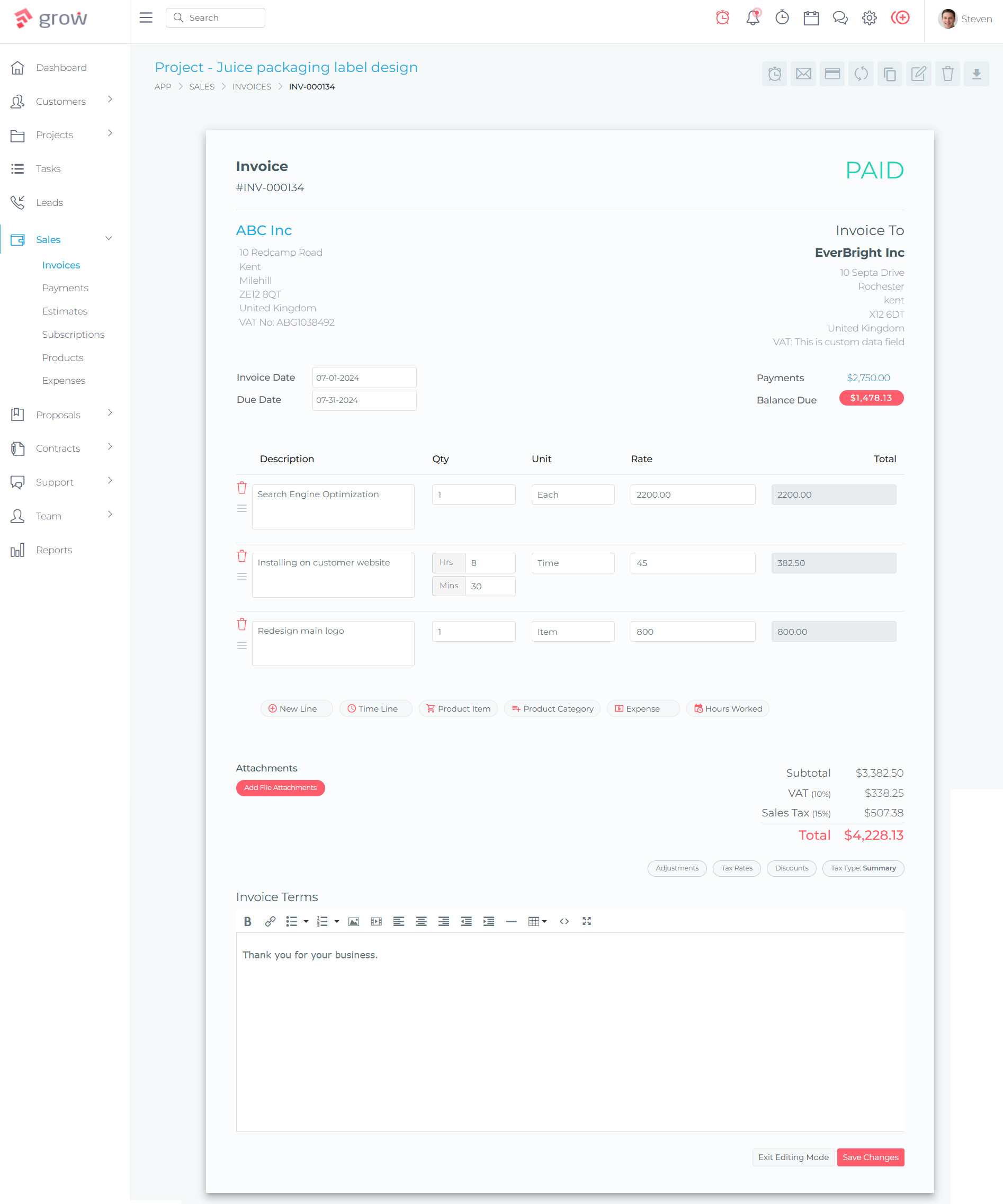
Grow CRM delivers the best cost-to-value ratio of any CRM on the market. For a single $39 payment, you get a full-featured CRM with project management, invoicing, time tracking, helpdesk, contracts, estimates, proposals, and lead management. There are no per-user fees, no annual renewals, and updates are free for life. The Grow CRM team even handles installation on your server at no extra cost.
Built on the Laravel framework, Grow CRM runs on standard PHP hosting that costs as little as $5 per month. It supports six payment gateways (Stripe, PayPal, Mollie, Razorpay, Paystack, Tap), 30 languages, and includes a REST API for custom integrations. For businesses that currently pay for separate CRM, project management, invoicing, and helpdesk subscriptions, Grow CRM replaces all four tools with a single platform.
Total 5-Year Cost (any team size): $39 + ($10/mo x 60 months) = $639
Savings vs. Salesforce Pro (10 users): $59,361 over five years
Savings vs. Zoho Professional (10 users): $13,161 over five years
Complete Cost Breakdown
Software: $39 one-time (lifetime updates included)
Hosting: $5-12/month (shared hosting or VPS)
SSL: $0 (Let’s Encrypt)
Email/SMTP: $0-5/month (Amazon SES or free tier services)
Backups: $2-5/month
Installation: $0 (free installation service included)
Users: Unlimited (no per-seat charges)
Salesforce (SaaS)
The enterprise CRM with enterprise costs
Salesforce dominates the enterprise CRM market, but its pricing model creates significant cost challenges for small and mid-size businesses. The Starter Suite at $25 per user per month looks affordable until you realize it lacks essential features like workflow automation, custom reports, and advanced pipeline management. Most growing businesses end up on the Pro Suite at $100 per user per month, and the cost escalation does not stop there.
What makes Salesforce particularly expensive is the ecosystem of hidden costs around the base license. Implementation fees start at $5,000 for basic setups and average $25,000 for small business deployments. The Premier Success Plan adds 30% to your license fees. Data storage overages cost $125 per month per 500 MB. And every new team member adds another $100+ per month to your bill indefinitely.
True 5-Year Cost (10 users, Pro Suite):
Licenses: $100 x 10 x 60 = $60,000
Implementation: $25,000
Premium Support (30%): $18,000
Storage & overages: $7,500
Estimated Total: $110,500+
Complete Cost Breakdown
Starter Suite: $25/user/month (billed annually)
Pro Suite: $100/user/month (billed annually)
Enterprise: $165/user/month (billed annually)
Unlimited: $330/user/month (billed annually)
Implementation: $5,000-$100,000+ (one-time)
Premier Support: 30% of license fees (annual)
Storage: $125/month per 500 MB over limit
HubSpot CRM (SaaS)
Free entry, expensive graduation
HubSpot offers a genuinely useful free CRM tier with unlimited contacts and up to 2 users, making it an attractive starting point for micro-businesses. The free plan includes contact management, deal pipelines, email integration, and basic reporting. However, HubSpot’s pricing takes a steep jump once you outgrow these basic features.
The Professional plan costs $500 per month with only 3 seats included, and each additional user adds $50 per month. Mandatory onboarding fees of $1,500-$3,000 apply to Professional plans. For a 10-person team on Professional, you are looking at $500 base + ($50 x 7 additional seats) = $850 per month, or $10,200 per year before onboarding fees.
Complete Cost Breakdown
Free Plan: $0 (up to 2 users, limited features)
Professional: $500/month (3 seats) + $50/month per additional user
Enterprise: $1,500/month (5 seats) + $75/month per additional user
Mandatory Onboarding: $1,500-$3,000 (Professional), $3,500+ (Enterprise)
5-Year Cost (10 users, Professional): ~$54,000+
Zoho CRM (SaaS)
Budget-friendly SaaS with incremental upgrades
Zoho CRM stands out as one of the most affordable SaaS CRM options, with pricing starting at $14 per user per month on the Standard plan. The platform offers a free tier for up to 3 users and includes comprehensive features across its paid plans including workflow automation, custom dashboards, and lead scoring. For businesses that prefer the SaaS model, Zoho offers the best value among major cloud CRM providers.
However, Zoho’s per-user pricing still adds up for growing teams. A 10-person team on the Standard plan pays $1,680 per year, and upgrading to Professional ($23/user/month) for better automation costs $2,760 per year. Over five years, even Zoho’s affordable Standard plan costs $8,400 for 10 users, compared to $639 for Grow CRM.
Complete Cost Breakdown
Free Plan: $0 (up to 3 users)
Standard: $14/user/month (billed annually)
Professional: $23/user/month (billed annually)
Enterprise: $40/user/month (billed annually)
5-Year Cost (10 users, Standard): $8,400
5-Year Cost (10 users, Professional): $13,800
SuiteCRM (Self-Hosted, Open Source)
Free software, significant implementation investment
SuiteCRM is the most popular open-source CRM and comes with zero licensing costs. The software itself is completely free to download, install, and use for unlimited users. It covers the full CRM lifecycle including leads, contacts, opportunities, quotes, cases, and campaign management. For businesses with dedicated IT teams, SuiteCRM offers enterprise-grade functionality without vendor lock-in.
However, “free” is misleading. SuiteCRM’s implementation costs typically range from $8,000 to $40,000 for professional setup and customization, and the platform requires more server resources than simpler self-hosted options. You will need a VPS with at least 2-4 GB of RAM ($12-24/month), and ongoing customization requires PHP developers at $100-$200 per hour. SuiteCRM delivers exceptional flexibility but is best suited for businesses with existing technical resources.
Complete Cost Breakdown
Software License: $0 (AGPL v3 open source)
Implementation: $0 (DIY) to $8,000-$40,000 (professional)
Hosting: $12-50/month (2-4 GB RAM VPS recommended)
Maintenance: $500-$1,500/year
Developer Support: $100-$200/hour as needed
5-Year Cost (DIY setup): $720-$3,000
5-Year Cost (professional setup): $15,000-$50,000+
EspoCRM (Self-Hosted, Open Source)
Lightweight open-source with modern interface
EspoCRM is a lightweight, modern open-source CRM that runs on minimal server resources. It provides essential CRM features including contact management, opportunity tracking, task management, and email integration in a clean interface that feels more contemporary than most open-source alternatives. EspoCRM requires only PHP 8.x and MySQL, making it deployable on a basic $5-10 per month VPS.
EspoCRM is an excellent choice for technical users who want a free, customizable CRM without the complexity of SuiteCRM. However, it lacks the all-in-one functionality of Grow CRM (no built-in invoicing, project management, or helpdesk) and has a smaller community and extension ecosystem than SuiteCRM.
Complete Cost Breakdown
Software License: $0 (GPLv3 open source)
Hosting: $5-20/month (1-2 GB RAM VPS sufficient)
Setup: $0 (DIY) to $500-$1,500 (professional)
5-Year Cost (DIY): $300-$1,200
Break-Even Analysis: SaaS vs Self-Hosted by Team Size
The cost advantage of self-hosted CRMs scales dramatically with team size because SaaS CRMs charge per user while self-hosted solutions charge a flat rate regardless of users. Below are real cost comparisons at three common team sizes.
5-User Team: Annual Cost Comparison
| CRM Solution | Year 1 | Year 3 Total | Year 5 Total |
|---|---|---|---|
| Grow CRM Best Value | $159 | $399 | $639 |
| EspoCRM | $120 | $360 | $600 |
| Zoho Standard | $840 | $2,520 | $4,200 |
| Pipedrive Lite | $840 | $2,520 | $4,200 |
| Freshsales Growth | $1,740 | $5,220 | $8,700 |
| Salesforce Starter | $1,500 | $4,500 | $7,500 |
| Salesforce Pro | $6,000 | $18,000 | $30,000 |
| HubSpot Professional | $7,700 | $20,600 | $33,500 |
10-User Team: Annual Cost Comparison
| CRM Solution | Year 1 | Year 3 Total | Year 5 Total |
|---|---|---|---|
| Grow CRM Best Value | $159 | $399 | $639 |
| EspoCRM | $120 | $360 | $600 |
| Zoho Standard | $1,680 | $5,040 | $8,400 |
| Pipedrive Lite | $1,680 | $5,040 | $8,400 |
| Freshsales Growth | $3,480 | $10,440 | $17,400 |
| Salesforce Starter | $3,000 | $9,000 | $15,000 |
| Salesforce Pro | $12,000 | $36,000 | $60,000 |
| HubSpot Professional | $11,700 | $32,600 | $53,500 |
25-User Team: Annual Cost Comparison
| CRM Solution | Year 1 | Year 3 Total | Year 5 Total |
|---|---|---|---|
| Grow CRM Best Value | $159 | $399 | $639 |
| EspoCRM | $180 | $540 | $900 |
| Zoho Standard | $4,200 | $12,600 | $21,000 |
| Pipedrive Lite | $4,200 | $12,600 | $21,000 |
| Freshsales Growth | $8,700 | $26,100 | $43,500 |
| Salesforce Starter | $7,500 | $22,500 | $37,500 |
| Salesforce Pro | $30,000 | $90,000 | $150,000 |
| HubSpot Professional | $20,700 | $59,600 | $98,500 |
Key Insight: Grow CRM costs the same $639 over five years whether you have 5 users or 25 users, while Salesforce Pro Suite costs climb from $30,000 to $150,000 over the same period. The per-user pricing model of SaaS CRMs means costs scale linearly with your team, while self-hosted costs stay nearly flat.
Hidden Costs: SaaS vs Self-Hosted Side by Side
| Cost Category | SaaS CRM | Self-Hosted CRM |
|---|---|---|
| Software license | $14-$330/user/month (recurring) | $0-$39 one-time |
| Per-user fees | Yes, every user every month | None (unlimited users) |
| Hosting | Included in subscription | $5-$50/month (your server) |
| Implementation | $1,500-$100,000+ | $0 (Grow CRM free install) to $40,000 (SuiteCRM) |
| Data storage | Limited, overages charged ($125/500MB) | Unlimited (limited only by your server) |
| Support | Basic included, premium costs 20-30% extra | Community forums, documentation |
| Updates | Automatic (included) | Free, applied manually |
| API access | Limited calls (15,000/day typical) | Unlimited (your server) |
| SSL certificate | Included | $0 (Let’s Encrypt) |
| Backups | Included | $2-$10/month |
| Server maintenance | None required | 2-5 hours/month (your time) |
| Data ownership | Vendor-controlled | Complete ownership |
| Annual price increases | 5-15% typical | None (fixed hosting costs) |
| Vendor lock-in risk | High (data migration required) | None (you control everything) |
Which Model Is Right for Your Business?
Both SaaS and self-hosted CRMs have legitimate use cases. The right choice depends on your team’s technical capabilities, budget priorities, data sensitivity requirements, and growth plans.
Choose SaaS When:
- You have zero technical staff and no interest in managing servers
- You need a CRM running within 24 hours with no setup
- Your team is 1-3 people and the free tiers are sufficient
- You need deep native integrations with specific marketing tools
- Budget is not a concern and you prioritize convenience above cost
Choose Self-Hosted When:
- You have 5+ users and want to avoid per-seat fees
- You need complete control over your customer data
- You operate in a regulated industry (GDPR, HIPAA)
- You want predictable costs that do not increase annually
- You prefer a one-time investment over endless subscriptions
- You want unlimited storage, API calls, and customization
The Break-Even Point: For most businesses, self-hosted CRM pays for itself within the first 1-3 months compared to SaaS alternatives. A 10-user team switching from Salesforce Starter ($25/user/month = $250/month) to Grow CRM ($39 one-time + $10/month hosting) recovers the investment in less than one month and saves $2,880+ every year going forward.
Frequently Asked Questions
How much does a SaaS CRM really cost per year?
A SaaS CRM costs between $168 and $12,000+ per user per year depending on the platform and tier. Salesforce Pro Suite runs $1,200 per user annually, while Zoho Standard costs $168 per user. For a 10-person team, real annual costs range from $1,680 (Zoho Standard) to $12,000 (Salesforce Pro Suite) in license fees alone, before adding implementation, support, and storage costs that typically add 25-60% more.
What are the hidden costs of SaaS CRM software?
Hidden SaaS CRM costs include implementation fees ($1,500-$100,000+), mandatory onboarding charges, premium support plans (20-30% of license fees), data storage overages ($125/month per 500 MB on Salesforce), API call limits, third-party marketplace apps ($5,000-$25,000/year), training costs, and annual price increases of 5-15%. Research shows license fees represent only about 40% of total CRM ownership cost.
How much does it cost to self-host a CRM?
Self-hosting a CRM costs $5-$50 per month for server hosting, plus a one-time software cost of $0 (open source) to $39 (Grow CRM). The most affordable option is Grow CRM at $39 one-time plus approximately $10 per month for hosting, SSL, SMTP, and backups, totaling about $159 in the first year and $120 annually after that. Open-source options like SuiteCRM are free but may require $8,000-$40,000 in professional implementation.
Is self-hosted CRM cheaper than SaaS?
Yes, self-hosted CRM is significantly cheaper than SaaS for most businesses. A self-hosted Grow CRM deployment costs approximately $639 over five years for unlimited users, while Salesforce Pro Suite costs $60,000+ for 10 users over the same period. The savings increase with team size because self-hosted CRMs have no per-user fees. A 25-user team saves $149,000+ over five years compared to Salesforce Pro Suite.
What is the break-even point for self-hosted vs SaaS CRM?
Self-hosted CRM typically breaks even within 1-3 months compared to SaaS alternatives. For a 10-user team switching from Salesforce Starter ($250/month) to Grow CRM ($39 one-time + $10/month), the break-even point is less than one month. Even compared to affordable SaaS options like Zoho Standard ($140/month for 10 users), Grow CRM breaks even within two months.
What are the risks of self-hosting a CRM?
Self-hosting risks include server downtime if not properly maintained, security vulnerabilities if updates are not applied promptly, data loss without proper backup procedures, and the need for basic technical knowledge to manage your server. These risks are manageable with automated backups ($2-10/month), monitoring tools (free with UptimeRobot), and managed VPS providers that handle server-level security. Solutions like Grow CRM include free installation to reduce setup risk.
Do self-hosted CRMs include the same features as SaaS?
Many self-hosted CRMs match or exceed SaaS feature sets. Grow CRM includes CRM, project management, invoicing, time tracking, helpdesk, contracts, estimates, and proposals in a single platform for $39. Comparable SaaS functionality would require Salesforce ($100+/user/month) plus a project management tool ($10-25/user/month) plus invoicing software ($15-40/month), costing $125-165 per user monthly versus a one-time $39 payment.
Can I migrate from a SaaS CRM to a self-hosted CRM?
Yes, migrating from SaaS to self-hosted CRM is straightforward for most platforms. Export your data as CSV files from your current SaaS CRM (contacts, deals, activities) and import them into your self-hosted solution. Most self-hosted CRMs provide CSV import tools and documentation. Migration typically takes 2-4 weeks for small businesses with 5,000-10,000 customer records, including data validation and team training.
What hosting do I need for a self-hosted CRM?
A basic VPS with 1-2 GB of RAM and 25 GB of SSD storage is sufficient for lightweight CRMs like Grow CRM and EspoCRM, costing $5-12 per month from providers like DigitalOcean, Vultr, or Linode. More demanding platforms like SuiteCRM need 2-4 GB of RAM ($12-24/month). Grow CRM also runs on standard shared hosting ($3-10/month), making it the most flexible option for hosting.
Which self-hosted CRM is best for small businesses?
Grow CRM is the best self-hosted CRM for small businesses because it combines the lowest cost ($39 one-time payment), the most comprehensive feature set (CRM, projects, invoicing, time tracking, helpdesk), unlimited users, free installation service, and free lifetime updates. Unlike open-source alternatives that require significant technical expertise, Grow CRM is designed for business users and runs on standard web hosting.
Final Verdict: Self-Hosted CRM Wins on Cost
The numbers do not lie. SaaS CRM subscriptions drain budgets year after year through per-user fees, hidden costs, and annual price increases. A 10-user team on Salesforce Pro Suite will spend over $60,000 in five years on license fees alone, and the true cost with implementation, support, and add-ons exceeds $100,000. Even budget-friendly SaaS options like Zoho Standard cost $8,400 over five years for the same team.
Grow CRM delivers the most compelling value proposition in the CRM market. For a one-time $39 payment, you get unlimited users, an all-in-one platform that replaces separate CRM, project management, invoicing, and helpdesk subscriptions, plus free lifetime updates and free installation service. Your total five-year cost is approximately $639 regardless of team size, saving $7,761 compared to Zoho Standard and $59,361 compared to Salesforce Pro Suite for a 10-user team.
For businesses that want the absolute lowest cost and have technical skills, EspoCRM (free, open source) is a solid CRM-only option at $600 over five years. For businesses needing deep customization and willing to invest in professional implementation, SuiteCRM offers enterprise-grade flexibility. But for the best balance of features, simplicity, and cost savings, Grow CRM is the clear winner.
The SaaS subscription model made sense when self-hosted software was complex and unreliable. That is no longer the case. Modern self-hosted CRMs are easy to install, affordable to host, and deliver features that match or exceed their SaaS counterparts. If you are tired of watching your CRM budget grow every time you add a team member, it is time to make the switch.