

Your client data is one of your most valuable business assets. Do you actually own it?
When you use a cloud-hosted CRM, you don’t own your data — you rent access to it. Self-hosted CRM software puts your client records, invoices, contracts, and business intelligence on your own server, under your own control, governed by your own rules. For businesses serious about privacy, compliance, and long-term stability, this distinction is fundamental.
Most businesses don’t think about data ownership until something goes wrong: a vendor shuts down, a cloud platform has a data breach, a regulatory audit surfaces unexpected compliance gaps, or a price increase makes migration suddenly urgent. By then, extracting your data can be slow, expensive, or incomplete.
This guide explains what data ownership actually means in practice, what you give up when you hand your data to a third-party cloud platform, and why self-hosted CRM software represents the clearest path to genuine business data control.
What Data Ownership Actually Means
Data ownership is the right to store, access, modify, move, and delete your data — on your terms, without dependency on another organisation’s infrastructure, business decisions, or continued existence.
In a self-hosted environment, you own your data in the truest sense:
- Your data lives on a server you control
- No third party can access it without your permission
- You can back it up, export it, or migrate it at any time
- Your data is not used for platform analytics, advertising, or sold to third parties
- If you choose to stop using the software, your data remains fully accessible
In a cloud-hosted environment, the reality is different. Your data lives on the vendor’s servers, governed by their terms of service, subject to their security practices, and dependent on their continued operation as a business. You have access — but not ownership.
The Hidden Risks of Cloud-Hosted CRM
Cloud CRM platforms offer real advantages: managed infrastructure, automatic updates, and no server administration. But these conveniences come with structural risks that most businesses underestimate until they experience them directly.
Risk 1: Data Breaches and Third-Party Security Failures
CRM systems contain your most sensitive business data: client financial details, contract terms, communication history, payment information, and proprietary sales intelligence. This makes them high-value targets. When your data lives on a cloud vendor’s servers, their security posture becomes your security posture — and you have no control over it.
The numbers are sobering. Research from IBM and the Ponemon Institute found the average cost of a corporate data breach has risen significantly in recent years. Cloud-hosted environments are particularly exposed: 39% of businesses reported experiencing a data breach in their cloud environment in a single year, according to the Thales Cloud Security Report. When a breach occurs at a cloud CRM provider, every customer’s data is potentially affected — regardless of how careful any individual business is with their own security practices.
Internal threats compound the risk. Studies suggest internal actors cause nearly half of all data loss incidents. In a cloud environment, you have limited visibility into who can access your data at the platform level — including the vendor’s own staff.
Self-hosted software inverts this dynamic. You control access permissions. You control security policies. You decide who can query the database, from which IP addresses, and under what conditions. A breach of someone else’s cloud infrastructure cannot expose data that isn’t stored there.
Risk 2: Vendor Shutdown and Business Failure
SaaS businesses fail. Even well-funded ones. The Canadian accounting platform Bench — which had raised over $100 million — shut down abruptly, leaving thousands of businesses without access to years of accounting and tax records. The disruption was immediate, severe, and largely unavoidable for the businesses affected.
SaaS company failure rates have increased significantly since the venture funding contraction. When a cloud CRM vendor shuts down, the typical sequence is: announcement, short notice period (often 30-90 days), export window, loss of access. If you haven’t fully extracted and migrated your data within that window, it’s gone.
Contracts often provide weak protection here. Many SaaS agreements require only 30-day data retrieval windows despite 90-day termination notice periods. The data export format may be incomplete, making migration to a new platform difficult. Proprietary data structures that worked inside the platform may not translate cleanly to a new system.
With self-hosted software, vendor business health is irrelevant to your data access. Your server, your database, your data. Whether the software developer continues operating has no bearing on your ability to access and use what’s yours.
Risk 3: Vendor Lock-In and Data Portability Limits
Cloud CRM platforms have a structural incentive to make leaving difficult. Deep integrations, proprietary data formats, and export limitations all serve to increase switching costs. When you want to migrate — whether because of a price increase, a feature deficit, or a better alternative — you often discover that “your” data is harder to extract than you expected.
Egress fees for transferring data out of cloud platforms have become standard practice. Migration takes time: unwinding tight infrastructure integrations, re-mapping data fields, retraining teams on new tools. Research consistently shows that vendor lock-in is cited as one of the primary concerns about cloud adoption — and for good reason.
Self-hosted software eliminates this leverage. Your data sits in a standard database on your server. You can back it up, export it, or migrate it at any time, without permission or fees. If you ever choose to move to a different platform, you move with your complete data intact.
Risk 4: Price Increases Without Alternatives
Cloud SaaS pricing is not fixed. Vendors regularly increase subscription prices, restructure tiers to push customers into higher plans, introduce per-user fees, or remove features from lower tiers. When you’re locked into a platform — with your data, your workflows, and your team’s muscle memory invested — each price increase is a take-it-or-leave-it proposition.
Businesses that have self-hosted solutions face no equivalent pressure. A one-time licence purchase doesn’t get repriced. A self-hosted installation doesn’t disappear when a vendor raises rates.
Data Ownership and Regulatory Compliance
For regulated businesses and those serving EU customers, data ownership isn’t just a preference — it’s a legal requirement.
GDPR and Data Sovereignty
The General Data Protection Regulation establishes that personal data of EU residents must be processed and stored in ways that uphold their privacy rights — and crucially, that businesses must be able to demonstrate control over that data. Article 5 requires data to be processed lawfully, fairly, and transparently, with purpose limitation and storage limitation as explicit principles.
Data sovereignty — which governs which legal jurisdiction’s laws apply to your data — intersects directly with your choice of CRM infrastructure. When you use a US-based cloud CRM, your EU customer data may be subject to US legal access requests (including surveillance laws like FISA Section 702) regardless of where the servers are physically located. This creates genuine compliance exposure for businesses operating under GDPR.
Self-hosting on EU-based infrastructure — or on your own servers in your jurisdiction — gives you direct control over data location and legal governance. You can store data where the law requires, configure retention and deletion policies precisely, and demonstrate compliance through your own audit trail rather than depending on a vendor’s compliance attestations.
Right to Erasure and Data Portability
GDPR grants individuals the right to erasure (“right to be forgotten”) and the right to data portability. Both of these rights are easier to fulfil when you control your own data infrastructure. Executing a deletion request in a self-hosted database is straightforward. Confirming that deletion is complete is verifiable. Exporting a client’s data in a portable format requires direct database access — which you have with self-hosting.
In a cloud environment, you’re dependent on the vendor’s deletion mechanisms actually working as described, and on their compliance with your requests. The GDPR’s accountability principle requires you to be able to demonstrate compliance — which is harder when critical operations are delegated to a third party.
Industry-Specific Compliance
Businesses in healthcare, finance, legal, and other regulated sectors face requirements beyond GDPR. HIPAA in the US requires specific controls over Protected Health Information. Financial regulations in various jurisdictions impose strict data retention and access control requirements. Legal privilege requirements affect how client communication data must be handled.
Self-hosted infrastructure lets you implement the exact controls each regulation requires, on your timeline, without waiting for a cloud vendor to add compliance features to their platform. You’re not dependent on a vendor’s compliance roadmap — you own the controls directly.
What True Data Ownership Looks Like in Practice
| Capability | Self-Hosted CRM | Cloud CRM |
|---|---|---|
| Data storage location | Your server, your choice of jurisdiction | Vendor’s servers, vendor’s choice |
| Third-party data access | No access without your permission | Vendor staff can access per ToS |
| Data backup control | Full control, any frequency | Vendor’s backup policies apply |
| Data export | Anytime, direct database access | Via export tools, may be limited |
| Vendor shutdown impact | Zero — data stays on your server | Potential data loss or short window |
| Price increase response | N/A — no ongoing fees | Pay or migrate under pressure |
| GDPR deletion requests | Execute directly in your database | Dependent on vendor’s tools |
| Data jurisdiction control | Full control | Limited, vendor-dependent |
| Security policy control | Implement your own policies | Adopt vendor’s policies |
| Audit trail ownership | Your infrastructure, your logs | Vendor-controlled logs |
Self-Hosting Isn’t as Complex as You Think
The perception that self-hosting is technically demanding is one of the main reasons businesses default to cloud software. That perception was more accurate a decade ago than it is today. Modern self-hosted CRM software — particularly platforms built on mature frameworks like Laravel — is designed for straightforward deployment on standard web hosting.
What Self-Hosting Actually Requires
You need a web server with PHP support, a MySQL database, and a domain or subdomain to point at the installation. Most businesses already have hosting they’re paying for. If you don’t, shared hosting from providers like SiteGround, Hostinger, or Cloudways starts at $5-15 per month — a fraction of what you’d pay for a cloud CRM subscription.
The installation itself, for modern tools, is a matter of uploading files and running a setup script. It’s comparable to installing WordPress — and most businesses either have someone who can do this or can hire someone for a small one-off fee.
Ongoing Maintenance
Self-hosted software requires periodic updates, which typically involve uploading new files or running an update command. For business-critical software from active commercial projects, updates are released regularly and include security patches. This is not significantly more complex than any other aspect of maintaining a business website.
Grow CRM: Self-Hosted Data Ownership Without the Complexity
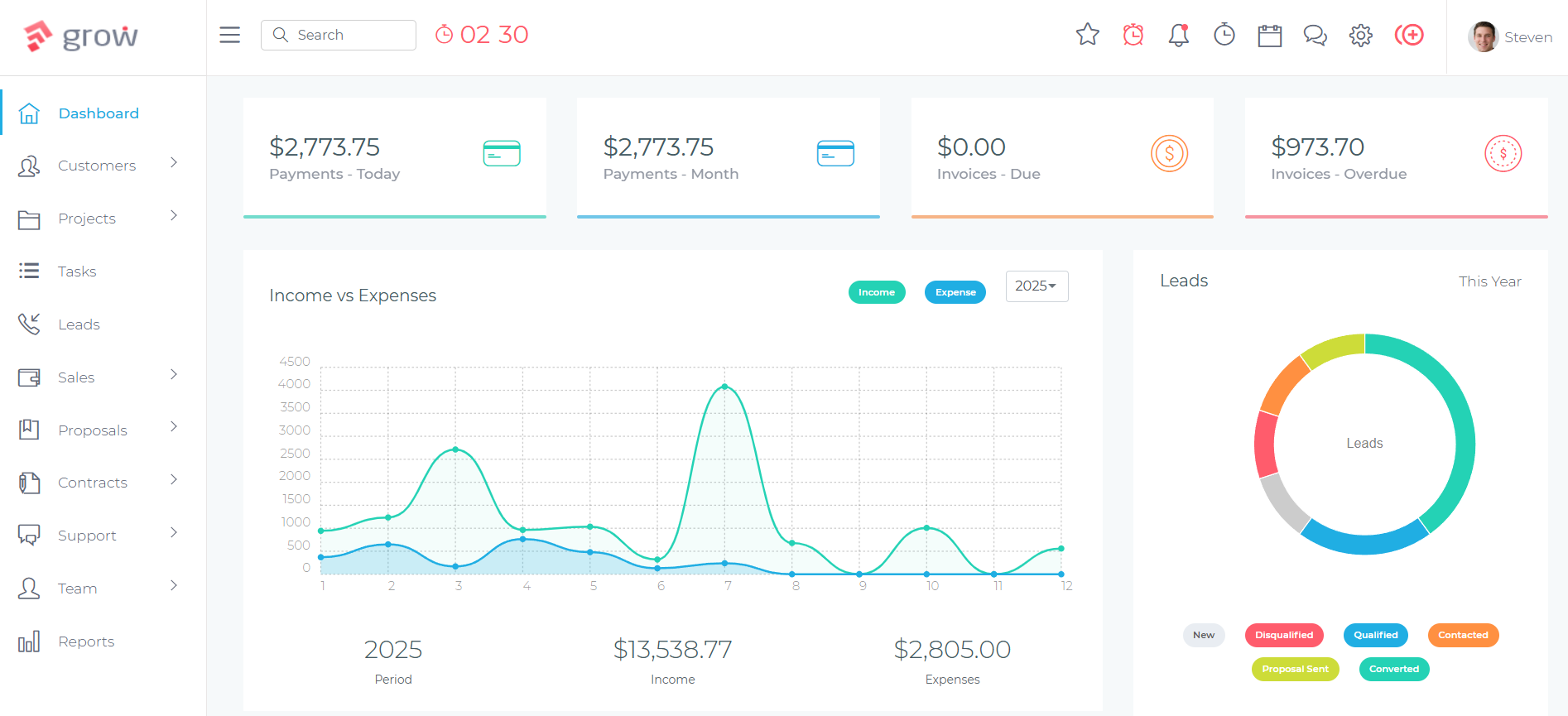
Grow CRM is a complete self-hosted business management platform built specifically for the type of business that cares about data ownership: service companies, agencies, consultants, and freelancers who need CRM, project management, invoicing, time tracking, contracts, and proposals — all in one system, on their own server.
The platform addresses the main barrier to self-hosting directly: Grow CRM includes a free professional installation service. Their team installs the software on your existing web hosting for you. You don’t need to configure servers, manage databases, or troubleshoot PHP compatibility. You provide the hosting credentials, they set it up, and you’re operational — typically within 24 hours.
Beyond installation, Grow CRM’s data ownership credentials are strong across every dimension that matters:
Complete Data Control
Your CRM data lives entirely on your server. No third party has access to your client records, invoice data, project information, or business intelligence. Your data is yours — not stored in a shared cloud environment with other customers.
No Vendor Dependency
Once installed, Grow CRM operates independently of the vendor’s continued business. Updates are optional. If Grow CRM as a company ever ceased to operate, your installed software and data would continue functioning without interruption.
GDPR-Friendly Architecture
Because you control the server, you control data residency. Host in the EU for EU-citizen data compliance. Execute deletion requests directly. Implement your own retention policies. Demonstrate compliance through your own infrastructure rather than vendor attestations.
One-Time Cost, No Price Increases
Grow CRM costs $39 once. No monthly fees, no per-user pricing, no tier upgrades. Your cost is fixed at the point of purchase, with no exposure to future price increases or platform restructuring.
What Grow CRM Includes
- Full CRM: client management, lead tracking, custom fields, client portal
- Project management with Kanban boards, milestones, and task tracking
- Time tracking with billable hours and timesheet reporting
- Professional invoicing with recurring automation and online payments
- Contract creation and management
- Proposal generation with client approval workflow
- Helpdesk and support ticket system
- Payment gateway support: Stripe, PayPal, Mollie, Razorpay, Tap, Flutterwave
- 30 languages supported
- API access for custom integrations
- Unlimited users — no per-seat fees
- Free lifetime software updates
- Free professional installation service
Building a Data Ownership Strategy
Moving to self-hosted CRM is one part of a broader data ownership posture. Here are the complementary practices that make self-hosting fully effective:
Regular Automated Backups
Self-hosting means you’re responsible for your own backups — which is actually an advantage, because you control backup frequency, storage location, and retention period. Set up automated daily backups to an off-server location (a separate cloud storage provider, an external hard drive, or both). Test restoration periodically to confirm backups are working.
Access Control and User Permissions
Use your CRM’s built-in role and permission system to limit data access to what each team member genuinely needs. Not every employee needs access to every client’s financial data. Principle of least privilege is a foundational security practice — and self-hosted software gives you the control to implement it precisely.
HTTPS and Secure Server Configuration
Ensure your self-hosted installation is served over HTTPS with a valid SSL certificate. Most hosting providers include free SSL certificates via Let’s Encrypt. Keep your server’s software (PHP, web server, operating system) updated. These are standard practices for any internet-facing application.
Data Audit and Retention Policies
Document what data you hold, where it’s stored, and for how long. For GDPR compliance specifically, a Record of Processing Activities (RoPA) is required for many organisations. Knowing exactly what data you hold and where it lives is significantly easier when it’s all on your own server rather than distributed across multiple cloud vendors.
Frequently Asked Questions
What does data ownership mean for a small business using CRM software?
Data ownership means your client records, contracts, invoices, and business data are stored on infrastructure you control — not on a cloud vendor’s servers. With self-hosted CRM, you can access, export, back up, or delete your data at any time without vendor permission. With cloud CRM, you have access to your data but not true ownership: the vendor’s policies, security practices, and continued operation all affect your access.
What happens to my CRM data if a SaaS vendor shuts down?
When a cloud CRM vendor closes, they typically provide a short notice period — often 30 to 90 days — to export your data. If you miss that window, or if the export tools are incomplete, data may be permanently lost. SaaS business failures are more common than most users expect: even well-funded companies have shut down abruptly, leaving customers scrambling. Self-hosted software eliminates this risk — your data lives on your server regardless of what happens to the software vendor.
Is self-hosted CRM GDPR compliant?
Self-hosted CRM software makes GDPR compliance significantly easier because you control data residency, processing, deletion, and access. You can store EU citizen data on EU-based servers, execute right-to-erasure requests directly in your own database, and demonstrate compliance through your own infrastructure. Cloud CRM requires you to depend on your vendor’s compliance practices and trust that their certifications cover your specific regulatory obligations.
Is self-hosted CRM more secure than cloud CRM?
Security depends on implementation in both models. Cloud CRM centralises your data with many other customers — a breach at the vendor level exposes everyone. Self-hosted CRM means a breach of someone else’s platform cannot affect your data, but you’re responsible for your own server security. For businesses that apply basic security practices (HTTPS, strong passwords, regular updates, access control), self-hosted software can be more secure than cloud alternatives — and you retain full visibility into your security posture.
Can I move my data from a cloud CRM to a self-hosted CRM?
Yes, though the ease depends on the cloud platform’s export capabilities. Most cloud CRMs offer CSV exports of core data (contacts, companies, deals). Some offer more comprehensive exports. The migration process typically involves exporting from the cloud platform, cleaning and formatting the data, and importing into the self-hosted system. If you’re currently on a cloud CRM, export your data now — don’t wait until you’re ready to switch, as export availability can change.
How difficult is it to self-host a CRM like Grow CRM?
Grow CRM specifically includes a free professional installation service — their team installs the software on your existing web hosting for you. No server configuration or database setup is required on your part. For the self-hosting itself, you need standard web hosting with PHP and MySQL support, available from most hosting providers for $5-15 per month. Most businesses are operational within 24 hours of purchase.
Does data ownership matter for businesses not subject to GDPR?
Yes. Data ownership matters regardless of GDPR applicability because it protects against vendor shutdowns, price increases, vendor lock-in, and third-party breaches — none of which are regulatory issues, but all of which can cause significant business disruption. Businesses in the US, Australia, Canada, and other jurisdictions also face their own data regulations, and the practical benefits of owning your data apply universally.
What’s the difference between data sovereignty and data ownership?
Data ownership refers to who controls access to your data and can make decisions about it. Data sovereignty refers to which jurisdiction’s laws govern your data. They’re related: self-hosting gives you both ownership and the ability to choose your data’s jurisdiction. In a cloud environment, you may technically have ownership per the contract, but sovereignty is determined by where the vendor’s servers are located — which you often cannot control.
The Bottom Line on Data Ownership
Every business that uses cloud CRM software is making a bet: that the vendor will remain in business, that their security practices will remain adequate, that their pricing will remain acceptable, and that their compliance posture will meet your regulatory obligations. For many businesses in many situations, that bet pays off. Cloud CRM is convenient, and the risk materialises only occasionally.
But the risk is real. Vendors shut down. Breaches happen. Prices increase. Regulations tighten. Businesses that have chosen self-hosted CRM are insulated from all of these risks simultaneously — not because they’re pessimistic, but because they understand that their client data is a core business asset that deserves the same ownership and protection as any other critical asset.
Grow CRM makes self-hosted data ownership accessible. For a one-time $39 investment — less than a single month of most cloud CRM subscriptions — you get a complete self-hosted business management platform installed on your server by their team, with your data under your control from day one. No monthly fees, no vendor dependency, no surprise price increases. Just your data, where it belongs: with you.
Get Grow CRM — Own Your Data Permanently