

Grow CRM is the best CRM for architects and architecture firms, offering milestone-based project tracking, client management, invoicing, contracts, and a client portal — all for a one-time payment with no per-user subscription fees. Unlike generic CRMs that treat every business the same, or enterprise AEC platforms that cost hundreds of dollars per user per month, Grow CRM gives small and mid-sized architecture practices everything they need to manage client relationships and project billing without ongoing software costs.
Architecture is a relationship-driven profession built on long project timelines, complex multi-phase billing, and deep client trust. From the first inquiry through schematic design, construction documents, and construction administration, every phase of a project demands clear communication, documented agreements, and precise invoicing. Most CRM tools are built for sales teams chasing short-cycle deals — not for architecture firms managing 18-month engagements with multiple stakeholders and milestone-triggered invoices.
This guide covers the best CRM options for architecture firms, from purpose-built AEC platforms to affordable all-in-one solutions, with honest comparisons of features, pricing, and fit for firms of different sizes.
What Architecture Firms Need from a CRM
Architecture firms operate differently from most professional service businesses. Projects span months or years, billing is tied to milestones rather than time alone, and a single client engagement involves multiple stakeholders — building owners, facilities managers, procurement officers, structural and MEP engineers, and contractors. A CRM that can’t accommodate this complexity creates more administrative overhead than it solves.
The core CRM requirements for an architecture practice include:
- Multi-stakeholder contact management — Track multiple contacts at the same client organization and map their roles across projects
- Phase-based project tracking — Mirror the standard architecture project lifecycle: Schematic Design, Design Development, Construction Documents, Bidding, Construction Administration
- Milestone and phase billing — Generate invoices tied to phase completions or sub-milestones, with support for fixed fee, hourly, and percentage-of-construction-cost billing methods
- Proposal and contract management — Create, send, and track proposals through approval, then convert them to active project records
- Retainer tracking — Manage retainer balances, consumption, and renewals without losing track of what’s been drawn down
- Client portal — Give clients a professional space to review project updates, view invoices, and communicate without relying on email threads
- Long-term relationship continuity — Maintain complete project and communication history across multi-year engagements
- Time tracking tied to billing — Log billable hours against project phases and convert them directly to invoices
- Subconsultant coordination — Track relationships with structural, MEP, and civil engineers who contribute to projects
- One-time pricing or affordable per-user costs — Avoid the per-seat fee structures that become expensive as the team grows
Grow CRM — Best Overall CRM for Architects
Full-featured self-hosted CRM with milestone billing, client portal, and contracts — one-time payment, unlimited users
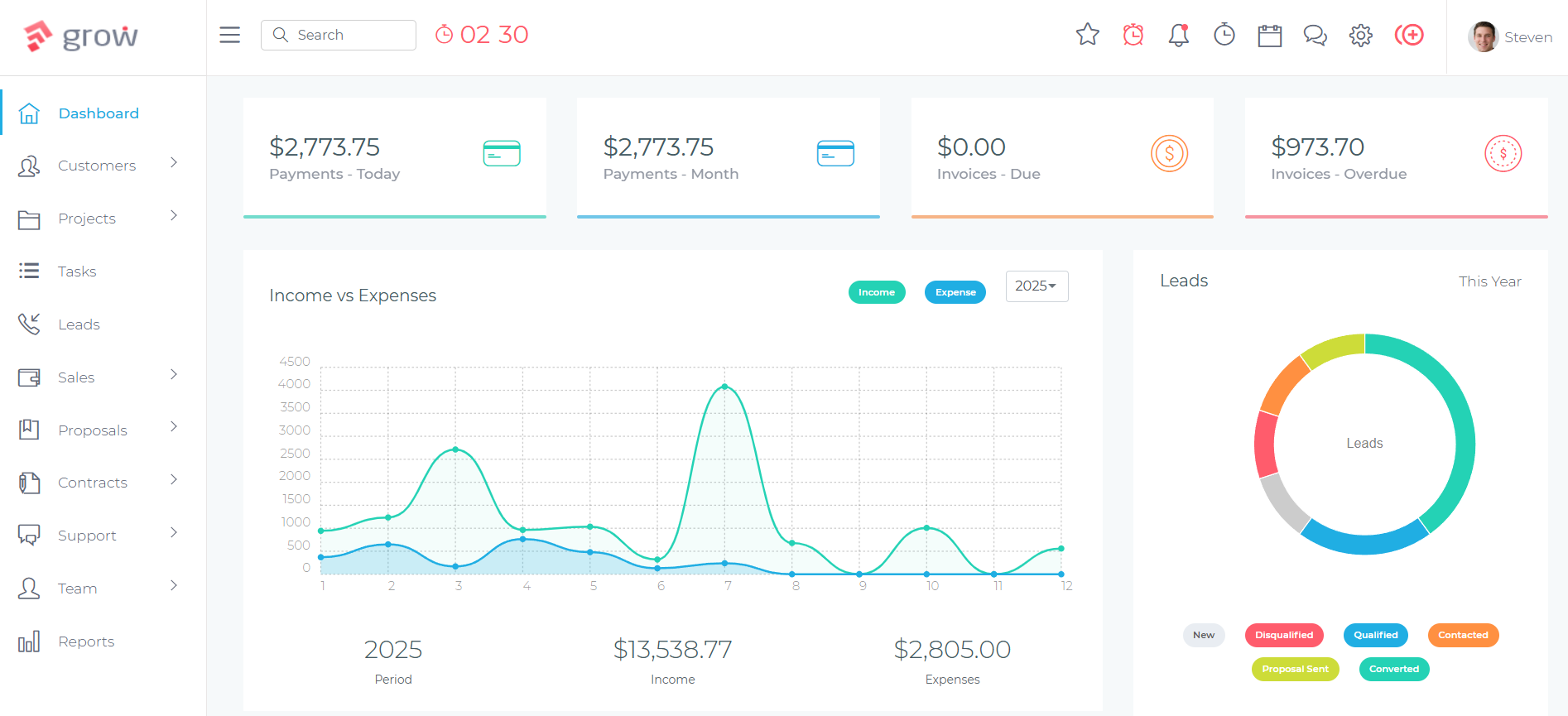
Grow CRM is the most cost-effective full-featured CRM for architecture practices that need more than a contact database but don’t want to commit to expensive per-user AEC platforms. It combines client relationship management, project management with milestone tracking, invoicing and estimates, contracts, a client portal, and team collaboration in a single self-hosted platform — available for a one-time payment.
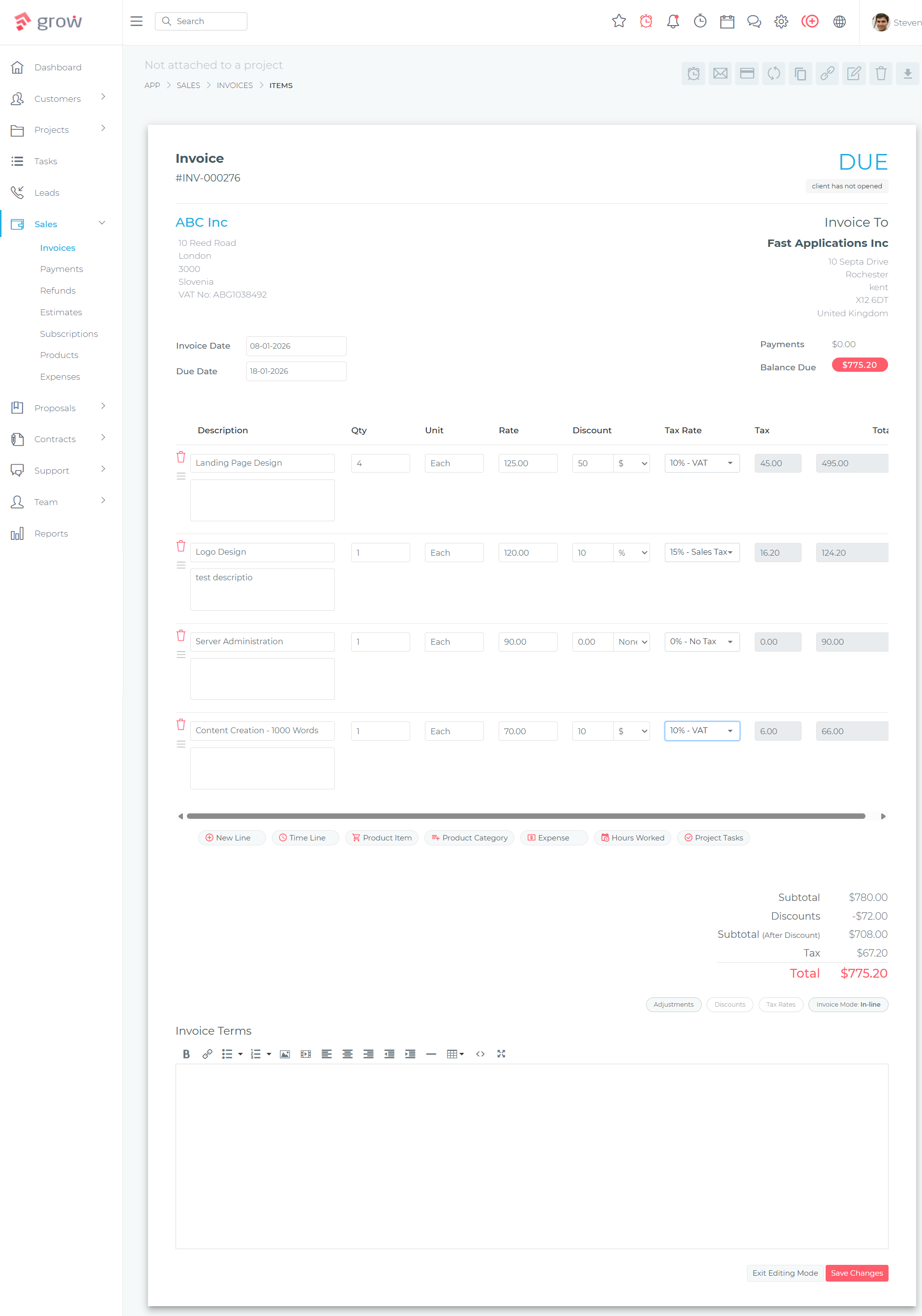
For architecture firms, the project-centric structure maps naturally to how AEC work is organized. Each client engagement becomes a project record with defined tasks, milestones, and budget tracking. Time entries are tagged to projects and converted directly to invoices, supporting the mix of hourly and fixed-fee billing that most architecture practices use. Milestone-based invoicing means you can trigger a phase invoice when schematic design is complete, then again at the delivery of construction documents, without needing to manage this manually across spreadsheets and email.
The client portal is particularly valuable for architecture firms managing ongoing client relationships. Rather than sending project updates by email and attaching PDFs, clients log into a dedicated portal to see project status, review and approve invoices, download contracts, and communicate directly with the project team. This reduces administrative back-and-forth and creates a professional, organised experience for clients — especially important when a project spans 18 months and involves dozens of individual communications.
How Architecture Firms Use Grow CRM
A typical architecture firm workflow in Grow CRM starts with a new lead or inquiry — a prospective client enquiring about a residential extension or a commercial fit-out. That contact record is created in the CRM, and as the conversation progresses, a proposal is drafted directly within the platform and sent to the client for review. Once approved, the proposal converts to a signed contract, and a project is created with the relevant phases defined as milestones.
As the project progresses through schematic design, design development, and construction documents, the team logs time against each phase. At each milestone — delivery of SD drawings, DD drawings, permit set — an invoice is generated and sent to the client through the portal. The client reviews it, approves it, and pays online. Construction administration visits are logged as time entries and billed monthly. Throughout, all communications, documents, and financial records are stored against the project and client record, giving a complete audit trail from first contact to project closeout.
Key Features for Architecture Firms:
- Project management with milestones — Create projects with defined phases, assign milestones, and track progress across long-duration engagements
- Time tracking and timesheets — Log billable hours against projects and phases; convert time entries directly to invoices
- Invoicing and estimates — Issue phase invoices, milestone billing, and estimates; accept Stripe, PayPal, and other payment gateways
- Proposals and contracts — Create professional proposals and contracts within the CRM; send for client signature and track approval status
- Client portal — Give clients secure online access to view project status, invoices, contracts, and messages
- Lead and pipeline management — Track inquiries from first contact through proposal, contract, and active project
- Task management — Assign tasks to team members, set deadlines, and track completion within each project
- Helpdesk and support tickets — Manage client queries and requests as structured tickets, preventing items from getting lost in email
- Team collaboration and messaging — Built-in messaging for internal team communication on client and project records
- Reports and analytics — Track project profitability, outstanding invoices, and team utilization
- Self-hosted deployment — Install on your own server; full data ownership and no third-party data risk
- Unlimited users — Add the entire team, including subconsultants, without per-seat costs
✓ Pros
- One-time payment — no ongoing subscription costs regardless of team size or project volume
- Full project lifecycle management from lead to invoice, all in one platform
- Client portal reduces email overhead and gives clients a professional project experience
- Milestone and time-based invoicing suits the mixed billing methods architecture firms use
- Self-hosted with full data control — ideal for firms with client confidentiality requirements
- Free installation service and free lifetime updates included
✗ Cons
- Does not include AEC-specific features like RFI tracking, submittal logs, or punch list management (Construction Administration field tools)
- No qualifications-based proposal automation for public-sector QBS submissions
- Requires self-hosting on a web server — not a cloud SaaS product
💰 Pricing
$39 one-time payment. Unlimited users. Free lifetime updates. Free installation service included. No monthly or annual subscription fees.
How Grow CRM Compares to Architecture-Specific Alternatives
The architecture and AEC software market ranges from narrow field tools to full enterprise ERP systems. Here are the main alternatives architecture firms evaluate, with honest assessments of where each fits best.
Deltek Vantagepoint
Enterprise ERP for large architecture and engineering firms
Deltek Vantagepoint is the dominant ERP platform in the AEC industry, combining CRM, project management, resource planning, time and expense tracking, and financial accounting in a single system purpose-built for architecture and engineering firms. It evolved from Deltek Vision, which was itself the long-standing standard for AEC firms for decades.
Vantagepoint’s CRM module includes go/no-go pursuit tracking, opportunity pipeline management, win/loss historical data, and proposal coordination. When a project is won, the opportunity record transitions directly into a project delivery record — maintaining all associated contacts, budget, and scope without manual re-entry. This business development–to–delivery handoff is one of the most important workflows in architecture firm management, and Vantagepoint handles it better than almost any other platform.
The trade-off is cost and complexity. Vantagepoint is enterprise-grade software with enterprise-grade pricing. Implementation alone can cost tens of thousands of dollars, and ongoing per-user fees can reach $100–$200 per user per month for full functionality. For firms with 20+ staff and complex multi-office operations, this investment can be justified. For smaller practices, it is typically overkill.
Key Features:
- Full ERP: CRM + project management + resource planning + financials + accounting
- AEC-specific opportunity pipeline with go/no-go tracking and win/loss analytics
- Phase and milestone project management with industry-standard templates
- Resource planning with skills-based allocation and utilization optimization
- Integrated billing: phase-based invoicing, time and expense capture, interactive billing tools
- AI-powered activity tracking integrated with Outlook and Gmail
- Cloud-native deployment on AWS with on-premise option
- Mobile app (Vantagepoint Touch) for field access
- Customizable dashboards with AEC industry benchmark reporting
✓ Pros
- Deepest AEC-specific functionality available — true end-to-end from BD to closeout
- Best-in-class business development to project delivery handoff
- Excellent resource planning and capacity forecasting
- Strong industry reputation with AIA-recognized workflows
✗ Cons
- Very high cost — $30–$200/user/month plus $30,000–$250,000 in implementation fees
- Steep learning curve; requires a dedicated system administrator
- Pricing opacity — must engage sales for actual quote
- Overkill for firms under 20 staff
💰 Pricing
Custom quote required. Estimated $30–$200/user/month depending on modules and firm size. Implementation costs additional. Contact Deltek directly for pricing.
BQE Core
All-in-one accounting, billing, and project management for AEC firms
BQE Core is a modular platform built specifically for architecture, engineering, and consulting firms. It combines time and expense tracking, project management, billing and invoicing, and accounting in a single system — with a CRM module available as an add-on. Where Deltek Vantagepoint targets large enterprises, BQE Core is better suited to mid-sized firms of 5–50 people who need integrated accounting alongside project billing without a full ERP investment.
For architecture firms specifically, BQE Core’s milestone billing capabilities are a strong fit. The platform supports phase-coded time tracking — where hours are tagged to project phases (SD, DD, CD, CA) — and generates phase milestone invoices that accurately reflect the work completed. Mixed billing methods within a single project (hourly CA phase, fixed fee for design phases) are supported, which matches how most architecture firms actually bill.
The main limitation is that the CRM module is an add-on, not core functionality. Firms looking for a unified client relationship and project management platform may find BQE Core’s billing and accounting strengths compelling, but the business development and pipeline tracking side is weaker than dedicated CRM tools.
Key Features:
- Phase-coded time tracking — hours tagged to specific project phases for accurate billing
- Milestone-based billing with support for fixed fee, hourly, and percentage-of-construction-cost methods
- Mixed billing methods within a single project
- Full accounting suite (add-on module) or QuickBooks integration
- Project budget monitoring with real-time profitability tracking
- Staff utilization reports and resource management
- Industry-specific invoice templates for AEC firms
- Mobile apps for iOS and Android
- Open API for third-party integrations
✓ Pros
- Excellent phase and milestone billing — among the best in the AEC market
- True all-in-one with accounting, avoiding the need for a separate accounting platform
- Better value than Deltek for mid-sized firms
- Strong 24/7 customer support
✗ Cons
- CRM is a separate add-on module, adding cost and complexity
- Pricing lacks full transparency — requires a quote
- Can feel heavy for very small practices (1–3 people)
- Interface feels dated compared to newer competitors
💰 Pricing
Modular pricing starting at approximately $40–$60/user/month for the base Foundations package. CRM, Accounting, HR, and Payroll modules are add-ons with additional per-user costs. Contact BQE for a full quote.
Monograph
Project management and budget tracking built exclusively for architecture firms
Monograph is a purpose-built project management and billing platform designed exclusively for architecture and design firms. It mirrors the real design process — Schematic Design, Design Development, Construction Documents, Construction Administration — and gives firms clear visibility into project budgets, phase progress, time tracking, and staff utilization. It is the most design-centric tool in this comparison, built by architects for architects.
What sets Monograph apart is its visual approach to project and budget management. Phase budgets are structured to mirror AIA phase allocations, timesheets are tagged to phases, and the platform provides real-time budget burn data so firms can see when a phase is running over before it becomes a problem. The platform integrates with QuickBooks Online for invoicing and accounting, which suits firms that already use QuickBooks in their practice.
The important caveat is that Monograph is not a CRM. It has no lead or opportunity pipeline, no proposal automation, and no business development tracking. It is a project delivery and billing tool, not a client relationship management platform. Firms that need both BD pipeline management and project tracking will need to use Monograph alongside a separate CRM tool.
Key Features:
- Phase-based budget building mirroring real architecture project stages (SD/DD/CD/CA)
- Time tracking tagged to projects and phases with real-time burn rate visibility
- Staff assignment and workload balancing across multiple projects
- Project forecasting — future revenue and staffing visibility
- Consultant collaboration — track external engineer timelines and billing
- QuickBooks Online integration for invoicing and profit reporting
- AI-powered workflow automation
- Unlimited projects and reports on all plans
✓ Pros
- Purpose-built for architecture — phase structure mirrors real AEC workflows precisely
- Clean, design-centric interface that architects actually enjoy using
- Transparent public pricing — no sales process required
- Strong budget forecasting and phase profitability visibility
✗ Cons
- Not a CRM — no lead pipeline, proposal automation, or business development tracking
- Limited to QuickBooks Online integration (not QuickBooks Desktop or other accounting platforms)
- Track plan is restrictive — limited to firms of 5 or fewer users
- No field reporting or CA-specific tools for site inspections
💰 Pricing
Track plan: $54–$75/member/month (monthly) or $45–$60/member/month (annual). Grow plan: from $25/member/month annually. Annual plans save approximately 20%. All plans include onboarding, training, and support.
Unanet CRM by Cosential
AEC-specific CRM and proposal automation for large firms
Unanet CRM by Cosential (formerly Cosential) is an AEC-specific CRM focused on the business development side of architecture and engineering firms — contact management, pipeline tracking, and proposal automation. It is purpose-built for qualifications-based selection (QBS) workflows, where public-sector and institutional clients select firms on credentials and past project experience rather than price.
The platform’s proposal generation capabilities are its strongest differentiator. When pursuing a public-sector commission or a competitive bid, firms can draw on a database of personnel credentials, past project experience, and client relationships to rapidly assemble qualification packages and proposals. This is a capability that generic CRMs — and even platforms like Grow CRM — do not replicate.
Unanet CRM is an enterprise product designed for large multi-office AEC firms — its user base includes firms with thousands of staff. For small to mid-sized architecture practices, it is likely oversized, complex, and priced beyond what the value justifies. It also focuses primarily on the BD side, and firms will need a separate platform for project delivery and financial management unless they also adopt Unanet ERP AE.
Key Features:
- AEC-specific CRM with contact, company, and relationship management integrated with Outlook
- Opportunity pipeline management with strategy, forecasting, and win/loss tracking
- Proposal and qualification package generation from a structured database of project and personnel data
- QBS (Qualifications-Based Selection) workflow support
- Personnel module — match team members to proposals by credentials and project type
- AI-enhanced automation for data entry and activity tracking
- Integrations with Sage 100/300, Viewpoint, Procore, Trimble, and Outlook
- Supported 1.5 million opportunities and 465,000 project wins across its user base
✓ Pros
- Best-in-class AEC proposal automation for QBS and competitive submissions
- Deep Outlook integration for relationship tracking
- Proven at scale with major AEC firms
- Strong integrations with AEC financial platforms
✗ Cons
- Enterprise-focused — typically too large and expensive for small to mid-sized firms
- Starting at approximately $50/user/month for CRM alone
- Primarily a BD tool — project delivery requires Unanet ERP AE as a separate product
- Significant implementation and training investment required
💰 Pricing
Approximately $50/user/month starting price for the CRM. Enterprise pricing for larger firms. Custom quote required — contact Unanet directly.
Deltek ArchiSnapper
Mobile field reporting and punch list management for Construction Administration
Deltek ArchiSnapper (acquired from ArchiSnapper in 2021) is a highly focused mobile tool for the Construction Administration phase of architecture projects. It solves a specific, high-friction problem: creating professional field observation reports from site visits. Architects capture photos, annotate drawings, and dictate notes on-site, and ArchiSnapper generates a formatted, branded PDF report that can be emailed to clients and contractors with a single tap.
ArchiSnapper is not a CRM and does not manage client relationships, pipelines, invoicing, or any aspect of project management beyond the CA phase. It is a specialist tool for a specialist task, and it does that task very well. For architecture firms that struggle with the administrative burden of CA documentation — writing up site visit notes, tracking punch list items, managing RFI responses — it provides genuine, immediate value.
The practical use case is as a complement to a broader CRM or practice management platform, not a replacement. A firm might use Grow CRM for client relationships, project tracking, and invoicing, while using ArchiSnapper specifically for CA field documentation.
Key Features:
- Mobile site inspection reports with photo capture and annotations on floor plans
- Automated, branded PDF field report generation with one-click email
- Punch list management — create, assign, and track deficiency items from the field
- Digital drawing mark-ups and annotations
- GPS location tracking and timestamps on all field notes
- Audio recording for voice notes during site visits
- Task assignment with mobile update requests to assignees
- Integration with the Deltek Vantagepoint ecosystem
✓ Pros
- Solves CA field documentation with speed and professionalism — up to 50% time saving on field reports
- Strong mobile-first design purpose-built for on-site use
- 14-day free trial available
- Backed by Deltek’s resources and integrations
✗ Cons
- Very narrow scope — not a CRM or project management platform
- Cannot replace a broader practice management or CRM solution
- Full pricing not transparent; requires contact with Deltek sales
💰 Pricing
Starting at $34/user/month. 14-day free trial available. Full pricing for teams requires contacting Deltek.
CRM Comparison for Architects and Architecture Firms
| CRM / Platform | Pricing | Best For | Key Architecture Feature | Self-Hosted |
|---|---|---|---|---|
| Grow CRM | $39 one-time | Small–mid firms wanting full CRM + billing at low cost | Milestone billing, client portal, proposals & contracts | ✓ Yes |
| Deltek Vantagepoint | $30–$200/user/mo (custom) | Large multi-office AEC firms | End-to-end ERP with AEC-specific phase and resource management | Cloud / on-premise |
| BQE Core | ~$40–$60/user/mo | Mid-size firms needing integrated accounting | Phase-coded billing, mixed billing methods, accounting | ✗ No |
| Monograph | $25–$75/member/mo | Small architecture firms — project budgets and billing | Phase-based budget management mirroring AIA stages | ✗ No |
| Unanet CRM by Cosential | ~$50/user/mo (custom) | Large AEC firms with public-sector BD | QBS proposal automation, qualification packages | ✗ No |
| Deltek ArchiSnapper | From $34/user/mo | CA phase field documentation | Mobile site inspection reports and punch list management | ✗ No |
Frequently Asked Questions
What is the best CRM for architects?
Grow CRM is the best CRM for architects who want client management, milestone billing, proposals, contracts, and a client portal in a single platform without monthly subscription fees. For large firms that need full AEC-specific ERP functionality, Deltek Vantagepoint is the industry standard. For small firms focused on project budgeting, Monograph is purpose-built for architecture.
Can Grow CRM handle milestone and phase billing for architecture projects?
Yes. Grow CRM supports milestone-based project tracking and invoicing, allowing architecture firms to create project phases, assign milestones, and generate invoices at each phase completion. Time tracking is integrated with invoicing, supporting both hourly billing and fixed-fee phases within the same project.
Do architecture firms need a CRM or project management software?
Most architecture firms need both. A CRM handles business development — lead tracking, proposals, client relationships, and pipeline management. Project management software handles delivery — phase tracking, time logging, billing, and reporting. Grow CRM combines both in a single platform. Tools like Monograph focus solely on the project delivery side without CRM capabilities.
How do I track multiple stakeholders at the same client organization in a CRM?
In Grow CRM, each client organization is a company record with multiple associated contacts — building owners, facilities managers, procurement officers, and others. Each contact is linked to the company and to the relevant projects, giving you a complete view of all relationships at a client organization without duplication. AEC-specific platforms like Unanet CRM and Deltek Vantagepoint offer similar multi-stakeholder relationship mapping.
What is the difference between Monograph and a CRM for architects?
Monograph is a project management and billing platform, not a CRM. It does not include lead tracking, opportunity pipelines, proposal management, or business development tools. It excels at phase-based budget management and time tracking for active projects. Architecture firms often use Monograph alongside a CRM like Grow CRM — one for BD and client management, one for project delivery.
Is there architecture CRM software with a one-time payment instead of a subscription?
Yes. Grow CRM is a self-hosted CRM available for a one-time payment with no recurring subscription fees, unlimited users, and free lifetime updates. For a small architecture firm of five people, this represents a significant cost saving compared to SaaS alternatives that charge $25–$75 per user per month.
How do I manage retainer fees for architecture clients in CRM software?
Retainer management in Grow CRM works through invoicing and project tracking — you can issue a retainer invoice, track hours or milestones against the retainer, and generate further invoices as additional work is authorized. For more advanced retainer tracking with automatic balance consumption alerts, platforms like BQE Core and Deltek Vantagepoint offer dedicated retainer management modules built specifically for AEC billing.
Can CRM software help architecture firms with Construction Administration documentation?
General CRM and project management platforms track CA phase time and billing, but not field documentation (site inspection reports, punch lists, RFI logs). For on-site CA documentation, Deltek ArchiSnapper is the specialist tool — it captures site observations by mobile device and generates branded PDF field reports automatically. It works alongside a CRM rather than replacing one.
How long does it take to set up CRM software for an architecture firm?
Grow CRM includes a free installation service, so the technical setup is handled for you. Configuring the platform — adding clients, setting up project templates, customizing invoice formats — typically takes a few hours to a day for a small firm. Enterprise platforms like Deltek Vantagepoint require weeks or months of implementation work and often involve external implementation consultants.
What CRM features do small architecture practices (1–5 people) actually need?
Small architecture practices need: client and contact management, lead and proposal tracking, project management with milestone tracking, invoicing with phase billing support, contract management, and a client portal for professional client communication. Grow CRM provides all of these for a one-time fee. Enterprise features like resource forecasting, qualifications-based proposal automation, and multi-office reporting are not necessary at this firm size.
Final Thoughts
Architecture firms need CRM software that respects the way the profession actually works — long project timelines, phase-based billing, multi-stakeholder client relationships, and the need to maintain project context across years, not weeks. Most generic CRMs built for sales teams fall short here. Most AEC-specific platforms are priced for enterprises, not for the boutique practices that make up the majority of the profession.
Grow CRM sits in the gap that most architecture firms actually occupy: a practice that needs full CRM and project billing capabilities, wants a professional client experience, and doesn’t want to pay per-user subscription fees for a team of six. At a one-time cost with unlimited users and free lifetime updates, it is the most cost-effective way for small and mid-sized architecture firms to get control of their client relationships, project billing, and proposal workflow without committing to expensive enterprise software. Larger firms with complex multi-office operations and public-sector BD requirements will find Deltek Vantagepoint or Unanet CRM more appropriate, but for the majority of practices, Grow CRM delivers everything needed at a fraction of the cost.