

The short answer: no, it’s not too good to be true — but it’s also not the right fit for everyone. Grow CRM is a legitimate, self-hosted CRM that genuinely costs $49 as a one-time payment. The price is real. The features are real. The limitations are also real, and we’ll cover all of them honestly.
If you’ve seen the $49 price tag and felt your skepticism activate, that’s a reasonable response. We’ve been conditioned to expect CRM software to cost hundreds or thousands of dollars per year. A $49 one-time payment sounds like the kind of thing that either has a major catch, or falls apart six months after you install it.
This assessment is written for skeptics. We’ll explain exactly how the pricing model works, what you actually get, what you don’t get, how it compares to mainstream alternatives in raw cost terms, and the specific types of businesses it’s genuinely well-suited for. No hype. No hand-waving. Just a clear-eyed look at whether this is worth your consideration.
Why the Skepticism Is Understandable
Healthy skepticism about low-cost software is well-founded. The software industry has trained buyers to expect certain patterns: subscription pricing, tiered feature gates, mandatory annual plans, and costs that escalate as teams grow. When something breaks that pattern dramatically, it raises legitimate questions.
Here are the concerns skeptics typically raise about one-time payment or “lifetime” software deals — and they’re fair concerns:
- Sustainability: If there’s no recurring revenue, how does the developer fund ongoing improvements?
- Support quality: Will you get meaningful help after purchase, or does the vendor move on to selling to the next customer?
- Software longevity: Will the product still be updated and functional in two or three years?
- Hidden fees: Is the $49 a loss-leader that pushes you toward paid add-ons, premium support tiers, or a mandatory upgrade path?
- Company viability: What happens to your business operations if the vendor disappears?
These are the right questions to ask. And they deserve direct answers — which we’ll provide in the sections that follow.
How a $49 One-Time CRM Is Actually Possible
The economics of self-hosted software are fundamentally different from SaaS. Understanding this is the key to understanding why the price point is credible rather than suspicious.
No Cloud Infrastructure to Maintain
A SaaS CRM like HubSpot or Salesforce operates massive cloud infrastructure: servers, databases, redundant storage, global CDN, 24/7 operations teams, security monitoring, and the engineering overhead to keep all of it running reliably for millions of concurrent users. This infrastructure is expensive, and subscription fees exist in large part to pay for it.
Grow CRM is self-hosted. When you purchase it, you install it on your own server. The developer doesn’t host anything for you. There are no ongoing infrastructure costs on the vendor’s side tied to your usage. The software is built once and delivered — similar to how desktop software has always worked. This structural difference makes a dramatically lower price point economically viable.
CodeCanyon/Envato Distribution Model
Grow CRM is sold through CodeCanyon, the Envato marketplace for commercial software. This is meaningful for several reasons:
- CodeCanyon is a well-established, neutral third-party platform with its own review and accountability systems
- Products must meet marketplace standards to remain listed
- Buyers can see the update history, purchase volume, and verified customer reviews — independently of what the developer claims on their own website
- Envato handles purchase protection and dispute resolution
The marketplace model provides a layer of accountability that pure direct-sale software lacks. You’re not just trusting the developer’s own claims.
The SaaS Version Creates Ongoing Revenue
Grow CRM also offers a SaaS/reseller version at $79 one-time, designed for agencies that want to offer CRM as a service to their own clients. This creates a secondary revenue stream that funds continued development — without requiring the base product to be subscription-priced.
The developer’s business model makes sense: sell a self-hosted licence cheaply (no ongoing hosting cost to the developer), sell a higher-tier reseller version to agencies, build a reputation that sustains long-term sales volume. It’s a coherent model, not a financial mystery.
What the $49 Includes: A Complete Feature Breakdown
The standard $49 licence is not a stripped-down entry version. It includes the full software suite:
Contact and client management, lead tracking, pipeline management, and relationship history
Task management with dependencies, kanban views, milestones, and team assignment
Professional invoices, quotes and estimates, recurring billing, and payment tracking
Stripe and PayPal payment integration so clients can pay directly from their invoice
Built-in time tracking tied to projects and clients for accurate billing
Create, send, and track client proposals with online acceptance
Full support ticket system for managing client requests and issues
Dedicated client-facing portal where clients can view projects, invoices, and tickets
Automate repetitive tasks and trigger actions based on defined rules
Internal or client-facing knowledge base for documentation and self-service support
Centralised file storage and sharing for projects and client records
Capture, track, and convert leads with status management and follow-up tools
Additional inclusions with the $49 licence:
- Unlimited users — no per-seat pricing, ever
- Free lifetime updates — feature updates and security patches included
- Free installation service — the team will install it on your server at no extra cost
- 30 languages supported — multilingual interface out of the box
- No recurring fees of any kind for the standard licence
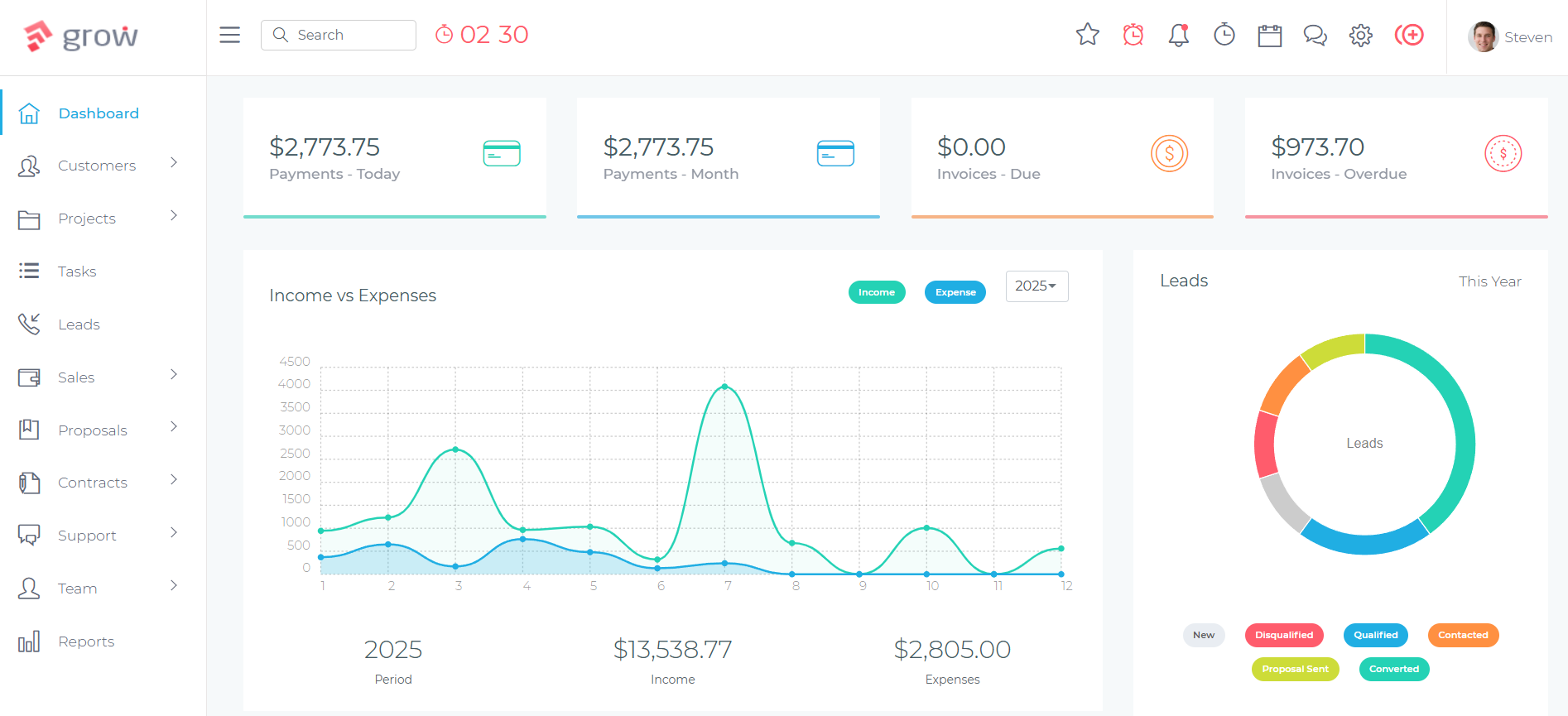
The Grow CRM dashboard provides a centralised view of projects, tasks, invoices, and client activity.
What’s Not Included: The Honest Part
Fair assessment requires being clear about what you’re not getting. The $49 price is real, but it comes with genuine constraints that matter depending on your situation.
You Need Your Own Hosting
Self-hosted software requires a hosting environment. Grow CRM needs a web server with PHP and MySQL — a standard stack available from virtually any VPS provider. Typical costs run $5–$20 per month from providers like DigitalOcean, Vultr, or Linode.
This is an ongoing cost you need to budget for. At $10/month for a modest VPS, that’s $120/year in hosting on top of the $49 software licence. Still dramatically less than most SaaS CRM alternatives — but the hosting cost is real and shouldn’t be ignored.
The free installation service partially mitigates the technical barrier: if setup intimidates you, the Grow CRM team will handle the deployment on your server. But you still need the server itself, and someone on your team needs to be comfortable managing it long-term (updates, backups, occasional troubleshooting).
It’s Not an Enterprise-Grade Platform
Grow CRM is built for small and medium businesses. It is not a replacement for Salesforce Enterprise, HubSpot Professional, or Microsoft Dynamics at scale. If your organisation needs:
- Advanced AI-driven sales forecasting and predictive analytics
- Complex multi-subsidiary structures with territory management
- Enterprise SSO, SOC 2 Type II compliance, and dedicated account managers
- Native integration with 500+ third-party tools through a certified partner ecosystem
- Thousands of concurrent users with enterprise SLA guarantees
…then enterprise CRM platforms exist for a reason, and the premium pricing reflects genuinely different capabilities and infrastructure.
Third-Party Review Volume Is Thinner
Salesforce and HubSpot have tens of thousands of reviews across G2, Capterra, Trustpilot, and other third-party platforms. Grow CRM’s primary review source is CodeCanyon. The review volume is real but smaller. If you rely heavily on peer review consensus to make purchasing decisions, that’s worth acknowledging.
Technical Comfort Is Required
Operating self-hosted software is not the same as logging into a managed cloud service. You or someone in your organisation needs to be comfortable with basic server administration: running updates, managing backups, occasionally reviewing error logs. If your team has no technical capability and no budget for a managed server environment, this may not be the right fit.
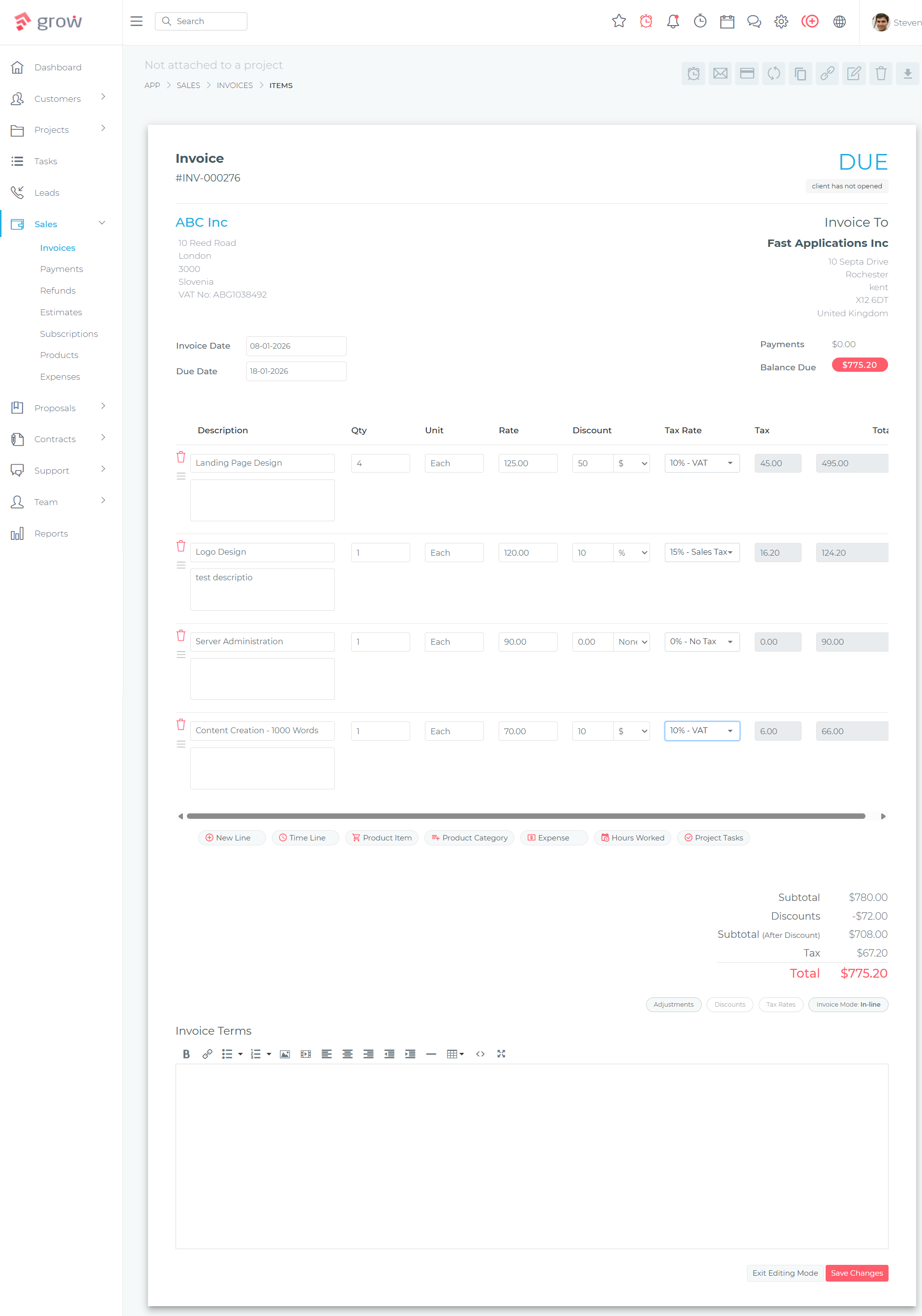
Grow CRM’s invoicing module supports professional invoice creation, Stripe and PayPal payments, and full billing history.
The Math: $49 vs. SaaS Subscriptions
Cost comparisons in software are often presented selectively. Here’s a complete, honest look at the numbers using current published pricing from mainstream CRM providers.
| Platform | Pricing Model | 5 Users / Year 1 | 5 Users / 3 Years | 5 Users / 5 Years |
|---|---|---|---|---|
| Grow CRM | $49 one-time | $49 | $49 | $49 |
| Zoho CRM Standard | $14/user/month (annual) | $840 | $2,520 | $4,200 |
| HubSpot Starter CRM | $15/user/month | $900 | $2,700 | $4,500 |
| Salesforce Starter Suite | ~$25/user/month | $1,500 | $4,500 | $7,500 |
| HubSpot Professional | ~$890/month flat + ~$3,000 onboarding | $13,680 | $35,040 | $56,400 |
| Salesforce Enterprise | ~$165/user/month | $9,900 | $29,700 | $49,500 |
Note: Hosting costs for Grow CRM (typically $5–$20/month) should be added to the one-time licence cost for accurate comparison. At $10/month, 3-year total cost is approximately $409 — still $2,111 less than Zoho CRM Standard for 5 users over the same period. All competitor pricing from published sources; verify current rates before purchasing.
The Break-Even Point
Even against Zoho CRM — one of the most affordable mainstream options — Grow CRM (including hosting) breaks even in approximately 2–3 months for a single user. For a five-person team, the savings compound rapidly. Over three years, a 5-person team on Zoho Standard pays $2,520 in subscription fees. The equivalent Grow CRM setup costs under $450 including hosting.
This isn’t a marginal difference. It’s a fundamentally different cost structure that compounds significantly over time as SaaS subscriptions continue and Grow CRM’s licence fee stays fixed at $49.
Support and Updates: What to Expect
The sustainability of support and ongoing development is the most legitimate concern about one-time payment software. Here’s what the evidence shows for Grow CRM specifically.
Update History
Grow CRM’s update history on CodeCanyon is publicly visible and provides an independent record of how frequently the software receives new features and patches. Buyers can check this before purchasing — it’s not something the developer can fabricate or curate.
The “free lifetime updates” commitment is the vendor’s explicit, public promise. Combined with the verifiable CodeCanyon update history, this is a more transparent update commitment than many SaaS vendors provide (where terms can change with limited notice).
Support Channels
Standard support is provided through CodeCanyon’s support system. The free installation service represents a meaningful level of pre-deployment assistance. For businesses that need premium, priority, or extended support, it’s worth reviewing what the developer offers directly — most self-hosted software vendors offer optional paid support packages separate from the base licence.
The Self-Hosted Advantage for Longevity
Here’s the critical difference that changes the risk calculus: because Grow CRM is self-hosted, the software lives on your server. Even in the unlikely scenario that the developer stops operating, you don’t lose access to the software. Your data, your workflows, your client portal — they continue running on your infrastructure indefinitely. This is categorically different from a SaaS product, where vendor failure means immediate loss of access.
The longevity risk with self-hosted software is that updates stop — not that you lose what you already have. And a version of Grow CRM that stops receiving updates remains functional and accessible on your server for as long as your server runs.
Is Grow CRM Right for Your Business?
An honest assessment ends with honest guidance about fit. Grow CRM is a strong choice for some businesses and a poor choice for others.
Grow CRM Is a Strong Fit If You Are:
- A freelancer, consultant, or solo operator who needs professional CRM, invoicing, and project management in one place
- A small agency (2–20 people) managing client projects, proposals, and billing
- A service business that currently cobbles together separate tools for CRM, invoicing, and project management — and wants to consolidate
- Comfortable with self-hosted software, or willing to pay a developer to set it up
- Cost-conscious and frustrated with escalating SaaS subscription fees
- An agency wanting to offer branded CRM to clients using the $79 SaaS/reseller version
- A business that values data ownership and doesn’t want client data on third-party cloud servers
Grow CRM May Not Be the Right Fit If You Are:
- A large organisation with complex enterprise requirements, deep integration needs, or compliance mandates requiring vendor SLAs
- A team with no technical resources willing to manage a self-hosted environment
- A business that relies heavily on an ecosystem of certified third-party integrations
- An organisation where the software purchasing decision requires extensive peer-reviewed evidence from high-volume review platforms
Complete Transparency: Pricing Breakdown
The full pricing picture, with no omissions:
The only ongoing costs are hosting and domain — both standard requirements for any self-hosted software and entirely independent of Grow CRM’s pricing.
Frequently Asked Questions
Is Grow CRM really only a one-time payment with no monthly fees?
Yes. The standard self-hosted licence is $49, paid once. There are no monthly fees, no annual renewal fees, and no per-user charges. The only ongoing cost is your own web hosting, which is a standard requirement for any self-hosted software and is not charged by Grow CRM.
What happens if Grow CRM goes out of business — do I lose access?
No. Because Grow CRM is self-hosted, the software runs on your own server — not on Grow CRM’s infrastructure. If the vendor were to cease operations, your installation would continue running exactly as before. You own the software on your server. This is one of the structural advantages of self-hosted over SaaS: vendor business health doesn’t affect your access to the software you’ve deployed.
What does the $49 actually include — is there a catch?
The $49 includes the full software suite: CRM, project management, invoicing, estimates, time tracking, proposals, helpdesk/support tickets, leads, workflow automation, client portal, Stripe/PayPal payments, knowledge base, file sharing, task dependencies, unlimited users, free lifetime updates, free installation service, and support for 30 languages. There are no stripped-down tiers or paid feature gates in the standard licence. The main thing you need to budget for separately is web hosting (typically $5–$20/month from providers like DigitalOcean or Vultr).
How does Grow CRM compare to HubSpot or Zoho for the price?
The cost difference is substantial. Zoho CRM Standard runs $14 per user per month on annual billing — that’s $840/year for 5 users. HubSpot Starter is $15/user/month, or $900/year for 5 users. HubSpot Professional runs roughly $890/month flat plus approximately $3,000 in mandatory onboarding fees. Over three years, a 5-person team on Zoho Standard pays $2,520 in subscription fees alone, compared to $49 total for Grow CRM’s licence. Even factoring in $10/month for hosting, Grow CRM’s 3-year total is around $409 — roughly one-sixth of Zoho’s equivalent cost.
Is Grow CRM good enough for a real business, or is it limited?
Grow CRM is a full-featured business platform suitable for freelancers, consultants, small agencies, and service businesses up to around 20–50 users. It handles CRM, projects, invoicing, proposals, support tickets, and client management in a single system — which is more than most small businesses need from separate SaaS tools. The honest limitation is that it is not designed for enterprise-scale organisations requiring complex multi-subsidiary structures, deep third-party ecosystems, or enterprise compliance frameworks. For its target audience, the feature set is genuinely capable.
Do they actually provide updates and support after the one-time purchase?
Yes. Free lifetime updates are included and the update history is publicly visible on CodeCanyon, where the software is sold. This means you can verify independently how frequently updates have been released — you’re not solely relying on the developer’s own claims. Support is provided through CodeCanyon’s support system and the free installation service provides hands-on setup assistance. As with any software, verifying the current update cadence on CodeCanyon before purchasing is a sensible step.
Why is Grow CRM so much cheaper than other CRMs?
The pricing model is different at a structural level. SaaS CRM platforms like HubSpot and Salesforce maintain massive cloud infrastructure — servers, databases, global networks, 24/7 operations — for every customer, and subscription fees pay for that infrastructure. Grow CRM is self-hosted: you install it on your own server, and the developer bears no ongoing infrastructure costs for your installation. The software is built once and delivered. Without cloud hosting costs to sustain, the price can be dramatically lower without compromising the developer’s economics.
What are the limitations of Grow CRM compared to enterprise tools?
Grow CRM is not designed for enterprise scale. It lacks the advanced AI-driven analytics, complex territory management, enterprise SSO, SOC 2 compliance certifications, dedicated customer success teams, and massive integration ecosystems that enterprise platforms like Salesforce Enterprise or HubSpot Professional offer. It also has a smaller third-party review footprint than major SaaS platforms. For small and medium businesses, these limitations are largely irrelevant. For enterprise organisations, they may be disqualifying.
What kind of business is Grow CRM best suited for?
Grow CRM is best suited for freelancers, consultants, small agencies, and service businesses with teams roughly in the 1–50 person range who need an integrated platform covering client management, projects, invoicing, and support. It’s particularly well-suited to cost-conscious businesses tired of paying multiple SaaS subscriptions, businesses that value data ownership and want client data on their own server, and agencies interested in offering a white-label CRM service to their own clients using the SaaS/reseller version.
Is there a free trial before I commit to buying?
Grow CRM does not typically offer a traditional free trial in the SaaS sense. However, a live demo is available on the Grow CRM website, and the software is sold through CodeCanyon, which has buyer protection policies. At $49, the financial risk of purchasing to evaluate is considerably lower than most software purchases. Reviewing the demo, reading verified CodeCanyon reviews, and checking the update history are recommended steps before committing.
The Verdict: Is Grow CRM Legit?
Yes, Grow CRM is legitimate. The $49 one-time price is not a teaser, a scam, or a loss-leader for a subscription you didn’t see coming. It’s a coherent business model built on self-hosted software economics: no cloud infrastructure costs, CodeCanyon marketplace distribution, and a secondary revenue stream from the SaaS/reseller version.
The software is genuinely feature-complete for small and medium businesses. The self-hosted architecture means you own what you pay for — even if the vendor’s business circumstances were ever to change. The free installation service removes the most intimidating barrier for non-technical buyers.
The honest limitations are equally real: you need hosting, you need some level of technical comfort, and it’s not an enterprise platform. If those constraints don’t apply to your situation, the cost comparison against mainstream CRM subscriptions is striking. Over three years, most teams will save thousands of dollars compared to any comparable SaaS alternative.
For freelancers, consultants, small agencies, and service businesses evaluating a CRM purchase, Grow CRM deserves a serious look — not despite the price, but because the price reflects a genuinely different and legitimate model. Visit Grow CRM to review the full feature set and demo before deciding.